Smoking can affect more than your lungs. Tobacco smoke and other inhaled irritants can also affect the lining of your nose and sinuses, which may contribute to congestion, irritation, drainage, and changes in how your nose feels.
If you regularly experience a stuffy nose, runny nose, post nasal drip, or sinus irritation after smoking or being around smoke, the exposure may be contributing to your symptoms.
How Does Smoking Affect Your Nose and Sinuses?
The lining of your nose and sinuses contains tiny structures called cilia. Cilia help move mucus, dust, allergens, and other particles through the nasal passages.
Tobacco smoke can irritate nasal tissue and interfere with normal cilia function. When mucus does not clear as effectively, congestion and drainage may become more noticeable.
Repeated smoke exposure may also contribute to ongoing inflammation in the nose and sinuses.
Can Smoking Cause Nasal Congestion?
Smoking can irritate and inflame the lining of the nasal passages. For some people, this can lead to swelling, increased mucus production, and a blocked or stuffy feeling in the nose.
Symptoms may be more noticeable after smoking, after repeated exposure, or when other conditions such as allergies or sinus inflammation are already present.
Can Smoking Cause Post Nasal Drip?
Smoking may contribute to post nasal drip by irritating the nasal passages and affecting how mucus moves through the nose and sinuses.
Post nasal drip occurs when mucus drains down the back of the throat. This can lead to:
- Frequent throat clearing
- Coughing
- A feeling of mucus in the throat
- Throat irritation
- Hoarseness in some cases
If post nasal drip is persistent, there may be other contributing factors such as allergies, sinus inflammation, reflux, or another ENT condition.
Can Smoking Cause a Runny Nose?
Smoke can act as an irritant to the nasal lining. In some people, that irritation may trigger increased mucus production and cause the nose to run.
A runny nose that repeatedly occurs after smoking or smoke exposure may be a sign that the nasal passages are reacting to the irritants being inhaled.
Can Smoking Cause a Stuffy Nose?
Yes, smoke exposure can contribute to nasal swelling and congestion. This may make the nose feel blocked or stuffy even when there is no infection present.
If nasal congestion continues even when you are not exposed to smoke, allergies, chronic sinusitis, structural nasal problems, or another condition may also be involved.
Can Smoking Affect Sinus Infections?
Smoking does not mean that every person will develop a sinus infection, but smoke exposure can irritate the nose and sinuses and may make existing sinus symptoms harder to manage.
If you already have a sinus infection, avoiding smoke may help reduce additional irritation while your sinuses recover.
For more information, read about smoking with a sinus infection.
Can Secondhand Smoke Affect Your Sinuses?
You do not have to smoke yourself to experience nasal irritation from tobacco smoke.
Secondhand smoke can irritate the nose, throat, and respiratory system and may make congestion, coughing, or sinus symptoms more noticeable in some people.
What About Vaping or Other Types of Smoke?
Vaping aerosols, marijuana smoke, cigar smoke, and other inhaled substances can also contain particles or chemicals that irritate the nose and respiratory system.
The exact effects vary depending on the substance, frequency of exposure, and the individual, but persistent congestion, drainage, or irritation after exposure should not be ignored.
Can Quitting Smoking Help Your Sinuses?
Reducing or stopping exposure to smoke removes an ongoing source of irritation from the nose and respiratory system.
Some people may notice improvements in congestion, coughing, nasal irritation, or their sense of smell after they stop smoking, although the amount of improvement and the timeline can vary.
If you need help quitting, your primary care provider can discuss treatment options and resources that may help.
When Should You See an ENT for Sinus Problems?
If congestion, post nasal drip, runny nose, sinus pressure, or nasal irritation keeps returning, an ENT can help determine whether smoke exposure is the main cause or whether another condition is also contributing.
Consider seeing an ENT if you experience:
- Persistent nasal congestion
- Recurring sinus infections
- Frequent post nasal drip
- Ongoing sinus pressure
- Reduced sense of smell
- Difficulty breathing through your nose
- Symptoms that continue even after reducing smoke exposure
Get Help With Sinus Problems in McAllen, TX
If smoking, allergies, or chronic sinus problems are affecting your breathing or comfort, Glatz Group can help determine what may be causing your symptoms.
Glatz Group provides sinus care in McAllen for patients throughout the Rio Grande Valley.
Get Answers About Your Sinus Symptoms
Book an Appointment
Post nasal drip happens when mucus from the nose and sinuses drains down the back of the throat. It can cause frequent throat clearing, coughing, irritation, a feeling of mucus in the throat, and sometimes a sore throat or bad breath.
Many cases improve with simple measures at home, but persistent or recurring post nasal drip may be related to allergies, sinus inflammation, reflux, infection, or another ENT condition.
How Do I Know If I Have Post Nasal Drip?
Post nasal drip can feel different from person to person, but common symptoms include:
- Frequent throat clearing
- A feeling of mucus draining down the throat
- Coughing, especially at night
- A sore or irritated throat
- Hoarseness
- Bad breath
- A feeling that you need to swallow often
These symptoms can also occur with other conditions, so ongoing symptoms may need an evaluation to determine the underlying cause.
What Causes Post Nasal Drip?
Post nasal drip is not a diagnosis by itself. It is a symptom that can develop for several different reasons.
Common causes include:
- Seasonal or environmental allergies
- Colds and other respiratory infections
- Sinus inflammation or sinusitis
- Dry air
- Smoke and other airborne irritants
- Changes in weather
- Reflux
- Structural nasal problems
Because treatment depends on the cause, persistent symptoms should not always be treated the same way.
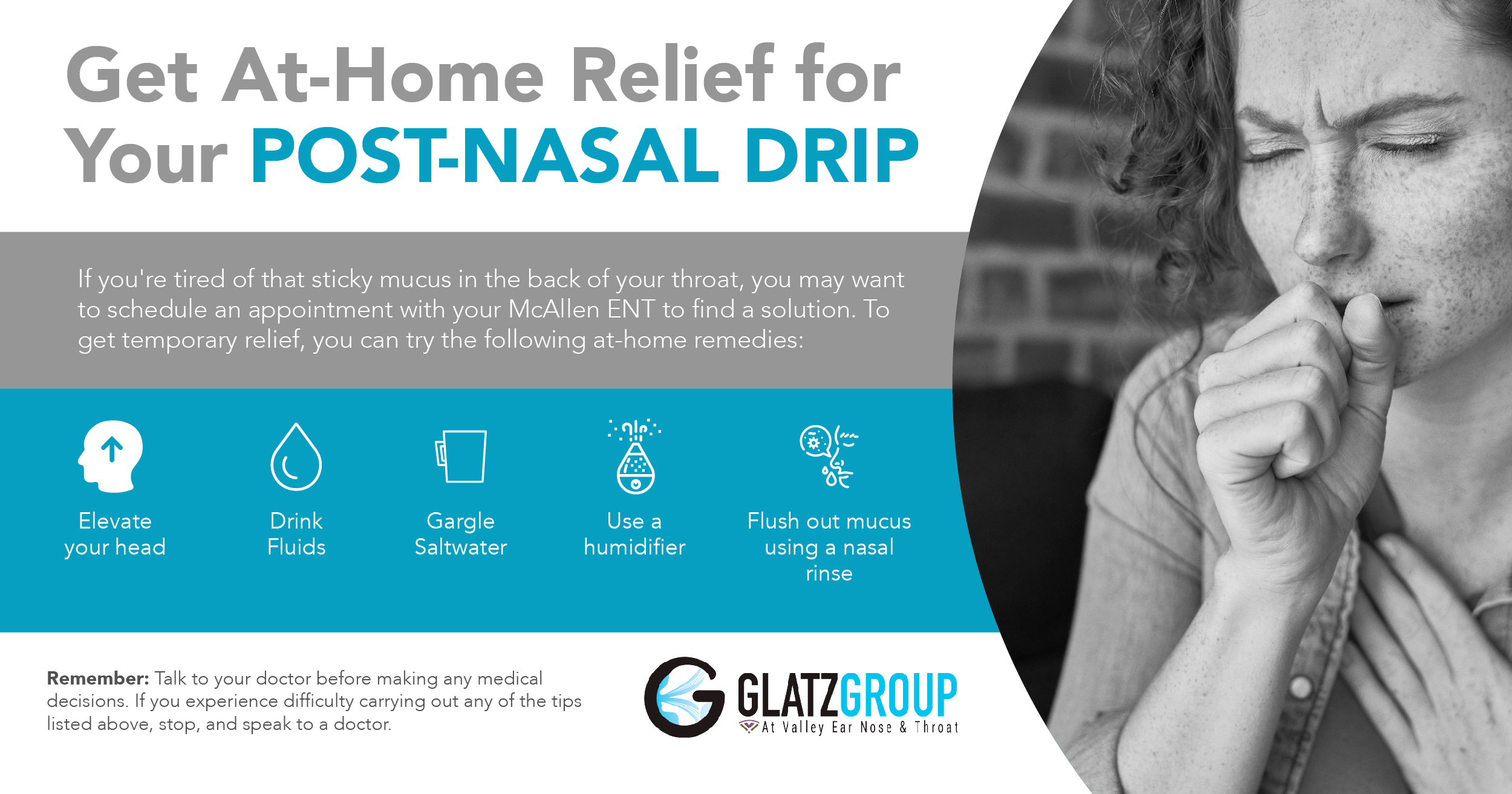
How Can I Treat Post Nasal Drip at Home?
If your symptoms are mild, there are several simple measures that may help reduce throat irritation and make mucus easier to clear.
Stay Hydrated
Drinking enough water can help keep mucus thinner and easier to clear.
Warm fluids may also feel soothing when post nasal drip is irritating the throat.
Use a Saline Nasal Spray or Nasal Rinse
Saline can help moisturize the nasal passages and remove mucus, allergens, and irritants.
If you use a nasal rinse, follow the product instructions and use water that is appropriate for nasal irrigation.
Use a Humidifier
Dry air can irritate the lining of the nose and throat. A clean humidifier may help add moisture to the air and make nasal irritation more comfortable.
Sleep With Your Head Slightly Elevated
Keeping your head and upper body slightly elevated may help reduce the feeling of mucus collecting in the throat while you sleep.
If nighttime sinus drainage is a frequent problem, read more about the best sleeping position for sinus drainage.
Gargle With Warm Salt Water
Warm salt water may help soothe throat irritation caused by drainage.
Avoid Smoke and Other Irritants
Tobacco smoke, vaping aerosols, strong fragrances, and other airborne irritants can worsen nasal and throat irritation.
If smoke seems to trigger your symptoms, read more about how smoking can affect the nose and sinuses.
Can Allergies Cause Post Nasal Drip?
Yes. Allergies can increase nasal inflammation and mucus production, which may lead to ongoing drainage down the back of the throat.
If your symptoms happen during certain seasons, around pets, dust, mold, or other triggers, allergies may be contributing.
Managing the allergy itself can be an important part of reducing post nasal drip.
Can Sinus Problems Cause Post Nasal Drip?
Sinus inflammation can increase mucus production and affect how mucus drains through the nose.
People with recurring sinus pressure, congestion, or sinus infections may also experience frequent drainage into the throat.
If post nasal drip occurs along with facial pressure, nasal obstruction, or recurring sinus symptoms, an ENT evaluation may help identify whether a sinus condition is contributing.
When Should You See an ENT for Post Nasal Drip?
Home care may be enough for mild symptoms, but persistent or recurring post nasal drip can sometimes signal an underlying problem that needs evaluation.
Consider seeing an ENT if you have:
- Symptoms that continue for several weeks
- Frequent or severe throat irritation
- Persistent coughing
- Recurring sinus infections
- Significant nasal congestion
- Difficulty breathing through the nose
- Reduced sense of smell
- Symptoms that repeatedly return after treatment
How Is Post Nasal Drip Treated at the Doctor’s Office?
Treatment depends on what is causing the drainage.
An ENT may examine the nose, throat, and sinuses and consider whether allergies, sinus inflammation, infection, reflux, structural problems, or another condition may be contributing.
Depending on the cause, treatment may involve medication, allergy management, treatment of a sinus condition, reflux management, or another approach based on the individual diagnosis.
Get Help With Post Nasal Drip in McAllen, TX
If post nasal drip keeps coming back, interferes with sleep, or causes ongoing coughing or throat irritation, Glatz Group can help determine what may be causing it.
Glatz Group provides sinus care in McAllen for patients throughout the Rio Grande Valley.
Get Answers About Your Post Nasal Drip
Book an Appointment
If you’ve ever experienced a feeling of pain or pressure in your ear, you know just how uncomfortable it can be. Perhaps it went away on its own, but if it has not, you may be wondering what could be causing this discomfort?
Today, your dedicated McAllen sinus relief specialists at the Glatz Group of Valley ENT will present you with all the information you need on Eustachian tube dysfunction.
About Eustachian Tube Dysfunction
The Eustachian tubes run from the middle ear to the back of the nose and throat. When functioning correctly, the tubes will open and allow air to flow through. Eustachian tube dysfunction (ETD) happens when the tubes will not open properly and in some cases, become blocked. This creates a feeling of pain and pressure in the ear.
The Causes
There are many different causes of ETD, and for many sufferers, the risk of dealing with ETD increases if they are coping with other existing illnesses. Common causes of ETD include:
- Allergies
- Cold or sinus infection
- Flying in an airplane or a change in altitude
- Smoking
- Sleeping face down on your stomach
- GERD
- Having a tumor in the throat or nose
The Symptoms
Everyone experiences different symptoms, and they can vary due to the severity of your case. Some of the most common symptoms you may experience with ETD include:
- A feeling of pressure or fullness in the ears
- A clogged sensation in the ear, causing everything to sound muffled
- Pain in either one or both ears
- A ringing sensation in one or both ears
- Popping, crackling, or clicking in your ears
- It may be hard to keep balance
If you suspect you are suffering from ETD, it is always best to visit an ENT you can trust to confirm your diagnosis.
The Treatment
There are a wide variety of treatments you can try for ETD, and depending on the severity, it may go away on its own. If that does not happen, here are a few treatment options you can try:
- Try at-home treatments to open up your eustachian tubes: Some examples your doctor may recommend are chewing gum, blowing with your mouth shut while pinching your nostrils, swallowing, or even yawning.
- Use an air pressure device: Your ENT may use an air pressure device to blow air into your nose and tubes to help relieve that pressure.
- Treat your allergies: In many cases, allergies are the sole cause of ETD. By treating your allergies with a decongestant, antihistamine, or nasal steroid, the swelling of your tubes may go down, helping air to flow more freely.
- Have surgery: There are two surgical procedures that can be done. The first being a myringotomy, where a hole will be made in your eardrum to release pressure and fluid buildup. The second procedure is a tuboplasty, where your eustachian tubes will be widened.
When To See A Doctor
If your symptoms worsen, you develop a fever, or have lost any amount of hearing, it is best to give your McAllen sinus relief specialists a call.
At Glatz Group of Valley ENT, our Physician Assistant (PA) Jonathan Lerma, is certified in treating Eustachian tube dysfunction.
Diagnosis and Treatment with Jonathan Lerma
There are many different ways Lerma can diagnose Eustachian tube dysfunction. The first being an exam of your eardrum while you breathe deeply and swallow. He will look at how the eardrum responds and make a diagnosis from that. The second way is by using a tympanometer to measure the pressure inside your ear.
Certified through Stryker, P.A. Lerma is trained in the treatment of Eustachian tube dysfunction. He will use a balloon dilation device to target the inflamed mucous and replace it with new, healthy mucous, relieving the pressure in your ear. This procedure has proven to be safe and effective for treating Eustachian tube dysfunction.
Relieve the Pain and Pressure in Your Ears After Visiting The Glatz Group of Valley ENT!
Eustachian tube dysfunction can have a variety of causes and treatments. At Glatz Group of Valley ENT, we are fully equipped to handle any case you bring our way!
YOUR TEXT
If you or someone you know is suffering from allergy or sinusitis symptoms, look no further than seeing the Glatz Group for all your ear, nose, and throat relief needs.
Certified physician assistant Jonathan Lerma devoted years of working by Dr. Frank R. Glatz’s side, and his right-hand team of sinus relief specialists at the Glatz Group of Valley ENT have the means to take care of your allergies, sinuses, sleep apnea, and other throat conditions.
Keeping Our Patients and Staff Safe and Healthy
Allergy season has been unforgiving this year, but getting sinus relief has never been easier or safer with us. We understand that COVID-19 is still an ongoing health crisis and concern for many, and that’s why we provide telemedicine, online services that address 90-95% of your sinus or allergy problems from the safety of your home.
In-person appointments are also available upon request, and you can rest assured knowing that we are going above and beyond to ensure the safety of our patients and staff by taking the following safety measures:
- Our physicians and staff are trained in infection control best practices, including the effective use of personal protective equipment such as masks, gloves, and goggles.
- You are required to wear a mask or face covering when in public. Please wear a mask during your visit, and only remove it if asked to do so by your physician.
- All clinical care areas are thoroughly cleaned and disinfected after each patient encounter. This has been our protocol long before the COVID-19 pandemic because of our commitment to guaranteeing the safest patient environment.
- We are asking that patients not bring anyone with them to their appointment, unless necessary due to disability or age. One parent or guardian may accompany the patient.
- We will continue to monitor this ever-changing situation with national Centers for Disease Control and Prevention (CDC) guidelines and local guidelines.
Quality Patient Care And Services
Every patient will be given undivided attention, with an ideal plan for relief sorted out based on their personal needs.
Ear
We provide a personalized approach to care and treatment of your hearing health. Our in-house audiologist can conduct same day hearing tests and assessments. Hearing disorders can be identified, diagnosed, and treated in patients of all ages, including infants, where we focus on:
- Cochlear Implants
- Bone Conduction Implants
- Ear Infections
- Hearing Loss
- Ruptured / Burst Ear Drum
- Tinnitus / Ringing in the Ear
- Vertigo and Dizziness
- Cerumen Removal (Ear Wax Removal)
- Failed Newborn Hearing Screenings
- Pediatric Ear and Hearing Disorders
- Ear Tumors
If you sense that something isn’t right, it is best to schedule an appointment as symptoms can worsen and diminish your quality of life.
Nose
We can identify, diagnose, and treat nasal and sinus conditions in patients of all ages, including infants. We carefully evaluate patients’ treatment options and offer customized treatment plans for:
- Allergies
- Sinusitis
- Nasal Obstruction
- Turbinate Dysfunction
- Nasal Polyps and Bone Spurs
- Deviated Septum
- Broken Nose
- Adenoid Hypertrophy
- Sleep Apnea
- Snoring
It is imperative to go through an examination if you experience any of the following listed above, as it can cause difficulty breathing, sleeping, and lead to serious health problems down the road if not treated.
Throat
Our team can detect and treat all kinds of throat, neck, and voice conditions such as:
- Snoring
- Sleep Apnea
- Hoarseness
- Vocal Cord Nodules
- Vocal Cord Dysfunction
- Vocal Cord Paralysis
- Diseases of the Thyroid and Parathyroid
- Tonsillitis
- Laryngopharyngeal Reflux
- Throat Infections
- Chronic Sore Throat
- Thyroglossal Duct Cysts
It is worth noting that the ear, nose, and throat functions are interconnected, making it important to treat to prevent any concerns to further avoid other health issues later on in life.
Balloon Sinuplasty
This minimally invasive procedure is an effective, lasting alternative for patients whose symptoms do not resolve with medication. If you suffer from sinusitis, you may want to consider if this is an option for you. We can determine if you are a candidate for this operation.
Our team is committed to resolving your sinus and allergy problems, whatever they may be. In fact, we guarantee it.
You can expect nothing short of the Glatz Guarantee, no matter who you see. Schedule an appointment with the Glatz Group of Valley ENT for sinus and allergy relief today!
Book an Appointment
If you have trouble breathing, despite taking medication to relieve your symptoms, chances may be that you are actually suffering from a deviated septum. This condition can result in a number of issues that medicine simply cannot fix.
If you're looking to ease sinus-related symptoms caused by a deviated septum, look into having a balloon sinuplasty procedure done.
Today, your certified McAllen physician assistant, Jonathan Lerma, and his sinus relief specialists here at the Glatz Group of Valley ENT, can help those with deviated septums better understand how it can affect their breathing and sinuses, and what options are available to alleviate those symptoms.
What Is a Deviated Septum?
Before understanding how deviated septums can impact your breathing and sinuses, we must first understand what the condition is.
A deviated septum is a physical disorder within the nasal septum, the part of the nose that separates the nasal cavity and forms the nostrils. The nasal septum is primarily made up of bone and cartilage, and is meant to symmetrically separate the nasal openings. When there’s a displacement in the nasal septum, the nasal passageways are no longer symmetrically separated. This creates a blockage in one of the nostrils.
The most common symptom of a deviated or crooked septum is difficulty breathing through the nose. The symptoms are typically worse on one side, and sometimes take place on the side opposite the bend. In certain instances, the crooked septum may interfere with the drainage of the sinuses, leading to recurring sinus infections.
In other cases, a person with a mildly deviated septum may experience symptoms only when they are dealing with an upper respiratory tract infection. For these individuals, in particular, a respiratory infection will provoke nasal inflammation that temporarily intensifies airflow issues associated with the deviated septum. Once the cold has passed, and the nasal inflammation subsides, symptoms of a slightly deviated septum usually resolve as well.
However, for individuals suffering from moderately to severely deviated septums, prolonging treatment will only increase the time you must deal with the symptoms. A deviated septum can result in:
- Obstruction of one or both nostrils
- Difficulty breathing
- Nasal congestion
- Nosebleeds
- Poor sinus drainage
- Sinus infections
- Sleep apnea
- Snoring
Treatment Options for Management of Symptoms
There are several options that may be recommended or prescribed to help you deal with symptoms associated with a deviated septum, including:
- Decongestants: Decongestants are medications that minimize nasal tissue swelling to help keep the airways of your nose open. Decongestants come as pills or nasal spray, but use nasal sprays with caution. Frequent and continued use can cause dependency and worsen symptoms after you stop using them.
- Antihistamines: Antihistamines are medications that help prevent allergy symptoms like a stuffy or runny nose. They can also sometimes help nonallergic conditions that occur during a cold. Please be aware that some antihistamines make you drowsy and can influence your ability to perform daily tasks that require physical coordination, including driving.
- Nasal steroid sprays: Prescription nasal corticosteroid sprays can lessen swelling in your nasal passage and help support drainage. It generally takes one to three weeks for steroid sprays to have their maximum effect, so it is imperative to follow your doctor's directions when taking them.
It is worth noting that medications only treat the swollen mucous membranes and symptoms associated with a deviated septum BUT WILL NOT correct a deviated septum.
Balloon Sinuplasty to Relieve Sinus-Related Symptoms
While balloon sinuplasty cannot straighten or correct a deviated septum, it can be used to help individuals obtain relief from sinus-related problems that are exacerbated by the condition.
This minimally invasive procedure does not require any bone or tissue to be removed. It simply uses a balloon catheter to widen the nasal cavity, helping to improve airflow and breathing for the patient. Once the balloon is inserted into the cavity of the affected region, it is slowly inflated to widen and remodel the sinuses.
The risks are small and the benefits can provide a comfortable life without breathing troubles.
Clear Your Sinuses and Breathing Problems With the Glatz Group of Valley ENT
As COVID-19 is still an ongoing health concern, we are doing everything in our efforts to ensure the safety and well-being of our staff and patients alike. For the sake of your comfort and peace of mind, we can address your symptoms online via telemedicine services or the phone.
If you need an in-office procedure, that can also be arranged upon request.
Nasal congestion and sinus pressure have several causes, including colds, the flu, and allergies. Regardless of your trigger, the symptoms that affect you can be quite bothersome, and even lead to headaches and other pains.
When you have a cold or are affected by allergies, the membranes lining your nasal passageways become inflamed and irritated, causing that stuffed up feeling. The membranes will then start to develop excess mucus to help flush out the source of the irritation, including any allergens.
With that being said, your certified physician assistant Jonathan Lerma and his team of sinus relief specialists at the Glatz Group of Valley ENT are glad to offer the following fantastic tips to help you avoid nasal congestion.
Sinus Pressure & Nasal Congestion: How to Avoid It
While it can be difficult to completely prevent sinus pressure and congestion, taking the following measures can help keep infections and allergies at bay:
- Wash your hands frequently. This is especially important in the colder months when viruses can live longer on doorknobs and other surfaces.
- Eat a well-balanced diet and exercise regularly. Staying healthy and active keeps your immune system on guard.
- Quit smoking. Cigarette smoke can irritate sinuses.
- Use a humidifier. Dryness can result in sinus pressure. You can run a hot shower and inhale the steam, or put a steaming towel over your head. If you use a humidifier, make sure you clean it frequently so that the humidifier itself doesn’t become a source of sinus problems.
- Don’t overdo the antibiotics. Antibiotics are helpful if you’ve got a bacterial infection, but they won’t do anything for viral infections. And if you take too many antibiotics, you can actually build up resistance to the medication.
- Use a saline nasal solution. You can buy a saline solution at the drugstore or you can make your own by mixing 1/4 teaspoon of salt with 8 ounces of warm water. The American Academy of Allergy, Asthma, and Immunology recommends using iodide-free salt and distilled water (or pre-boiled and chilled water). If you’re purchasing a premade saline drop, mist, or spray, make sure that it doesn’t include a decongestant.
- Try a neti pot. This nasal irrigation system allows a saline solution to be poured into the nasal openings, irrigating them to loosen mucus. Be sure to use only sterile, pre-boiled and cooled, or distilled water in your neti pot.
- Keep your windows closed. If you have allergies, try to avoid going outdoors or opening the windows, especially between 5 a.m. and 10 a.m., because that’s when the pollen count is at its highest.
- Fight dust mites. Vacuum and wipe down all surfaces regularly, decrease clutter that can trap dust, and use dust mite covers on your pillows and mattresses.
At-Home Treatments
When you’re stuffed up, focus on keeping your nasal passages and sinuses moist. Sometimes people believe that dry air may help clear up a runny nose, but in reality, it has the opposite effect. Drying out the membranes will only irritate them more.
You’ll find that some of the preventative measures are also methods to treat nasal congestion from home. To keep your nasal passages moist, you can:
- Take long showers or breathe in steam from a pot of warm (but not too hot) water.
- Stay hydrated and drink plenty of fluids. This will thin out your mucus, which helps prevent blocked sinuses.
- Prop yourself up. At night, lie on a few pillows. Keeping your head elevated can make breathing more comfortable.
- Avoid chlorinated pools. They can irritate your nasal passages.
Breathe Easier After Your Visit Glatz Group at Valley ENT
If you have nasal congestion and sinus pressure for more than seven days, even after using these approaches, it’s better to be proactive and seek options for relief through your local ENT specialists at Glatz Group.
If you have concerns about COVID-19, rest assured knowing that we’ve been following the CDC guidelines to ensure that our office is safe and clean for both our guests and staff. Thanks to telemedicine, we’ve been able to address 90 to 95% of our patients’ allergy symptoms online.
We also offer online consultations, phone calls, and in-person visits.
Let the Glatz Group at VALLEY ENT clear your congestion when you schedule your consultation now.