If your child has congestion that will not clear, thick nasal drainage, a cough that keeps hanging on, or repeated sinus symptoms, it may be more than just another cold.
Sinus infections can happen in children, and some children develop ongoing or recurring sinus inflammation that may need a closer look.
What Are the Signs of a Sinus Infection in a Child?
Possible symptoms include:
- Nasal congestion
- Thick or discolored nasal drainage
- A cough that does not seem to improve
- Post nasal drainage
- Bad breath
- Headache or facial pressure
- Ear pressure or discomfort
- Sore throat
- Fever
- Irritability
In children, sinus symptoms can overlap with colds, allergies, enlarged adenoids, and other nasal problems, so the length and pattern of symptoms matter.
Cold or Sinus Infection?
Most colds gradually improve.
A sinus infection becomes more likely when cold symptoms continue for more than about 10 days without improvement, become significantly worse after starting to improve, or are accompanied by more severe symptoms.
A child's doctor can help determine whether symptoms are more consistent with a viral illness, bacterial sinusitis, allergies, or another condition.
Why Does My Child Keep Getting Sinus Problems?
Recurring sinus symptoms can have several possible causes.
Frequent Respiratory Infections
Children are exposed to many respiratory viruses, especially in school and daycare settings. Repeated illnesses can make it seem like congestion never fully clears.
Allergies
Allergies can cause chronic swelling inside the nose and contribute to congestion, drainage, and difficulty breathing through the nose.
Learn more about allergies in children.
Enlarged Adenoids
Enlarged adenoids can contribute to chronic nasal obstruction, mouth breathing, drainage, and recurring nasal symptoms.
Learn more about enlarged tonsils and adenoids in children.
Chronic Nasal Inflammation
Some children develop ongoing inflammation inside the nose and sinuses that is not simply the result of one infection.
What Is Chronic Sinusitis in Children?
Chronic sinusitis means sinus and nasal symptoms continue for a prolonged period rather than clearing after a typical cold or short term infection.
Symptoms may include:
- Ongoing nasal congestion
- Persistent drainage
- Chronic cough
- Post nasal drip
- Difficulty breathing through the nose
- Recurring facial pressure or discomfort
- Reduced sense of smell
Chronic sinus problems can have several contributing factors, so treatment depends on what is driving the inflammation.
Can Sinus Problems Affect Sleep?
Yes. A child who cannot breathe comfortably through the nose may begin breathing through their mouth, snoring, or sleeping restlessly.
If your child has persistent congestion along with snoring or mouth breathing, learn more about snoring and sleep problems in children.
When Should My Child See an ENT?
An ENT evaluation may be helpful when:
- Congestion lasts for weeks
- Sinus symptoms keep returning
- Your child has repeated sinus infections
- Nasal breathing is difficult even when your child is not sick
- Symptoms continue despite appropriate treatment
- Allergies or enlarged adenoids may be contributing
- Sinus symptoms are affecting sleep or daily activities
How Are Sinus Problems Evaluated in Children?
The evaluation usually begins with a review of your child's symptoms, how long they have been present, and how often they return.
The ENT may examine the nose, throat, and airway and look for signs of inflammation, drainage, enlarged adenoids, or other nasal obstruction.
Depending on the situation, additional evaluation may include:
- Allergy testing
- Nasal endoscopy
- Imaging in selected cases
- Further evaluation for recurring or unusual infections
How Are Sinus Infections in Children Treated?
Treatment depends on the cause.
Viral infections do not require antibiotics. Bacterial sinus infections may be treated with antibiotics when appropriate.
Other treatment may include:
- Saline nasal sprays or rinses
- Hydration
- Humidification
- Treatment of allergies when present
- Medications to reduce nasal inflammation when recommended
What About Chronic Sinusitis?
Chronic sinusitis often requires a more individualized approach because ongoing inflammation may involve allergies, adenoid problems, structural issues, or other causes.
If symptoms continue despite medical treatment, an ENT can determine whether additional evaluation or other treatment options should be considered.
Sinus Care for Children in McAllen, TX
If your child has ongoing congestion, repeated sinus infections, chronic drainage, or difficulty breathing through the nose, Glatz Group can evaluate whether sinus inflammation or another ENT condition may be contributing.
Learn more about our ENT care for children in McAllen, chronic nasal congestion in children, and allergies in children.
Does your child keep dealing with congestion or sinus infections?
Book an Appointment
If your child seems to get sore throats over and over again, it can be difficult to know whether it is just another infection or something that should be evaluated more closely.
Frequent tonsillitis, repeated strep throat, and recurring throat infections can affect eating, sleeping, school attendance, and everyday comfort.
Why Does My Child Keep Getting Sore Throats?
Children can develop sore throats for several reasons, including viral infections, strep throat, tonsillitis, allergies, post nasal drainage, and irritation.
When sore throats happen repeatedly, the pattern becomes important. An ENT may look at how often the episodes occur, how severe they are, and whether they are affecting your child's daily life.
What Is Tonsillitis?
Tonsillitis is inflammation of the tonsils, which are located on both sides of the back of the throat.
Tonsillitis may be caused by a virus or bacteria.
Common Symptoms
- Sore throat
- Red or swollen tonsils
- White spots or coating on the tonsils
- Pain when swallowing
- Fever
- Swollen lymph nodes in the neck
- Bad breath
- Reduced appetite because swallowing hurts
Is Tonsillitis the Same as Strep Throat?
Not always.
Tonsillitis simply means the tonsils are inflamed. Strep throat is an infection caused by group A Streptococcus bacteria and can involve the tonsils and surrounding throat.
A rapid strep test or throat culture may be used when a bacterial infection is suspected.
What Does Recurrent Tonsillitis Mean?
Recurrent tonsillitis means a child continues to experience repeated episodes of tonsil or throat infection over time.
Keeping track of how often infections happen can be useful, especially if your child repeatedly misses school or requires medical treatment.
Helpful tip for parents: keep a simple record of the date of each throat infection, whether strep testing was positive, whether fever occurred, and what treatment was given.
How Many Throat Infections Are Too Many?
There is not one number that automatically means every child should have their tonsils removed.
Current ENT guidelines recommend watchful waiting for many children who have fewer than seven documented throat infections within one year, fewer than five per year over two years, or fewer than three per year over three years.
For children with more frequent documented infections, tonsillectomy may be considered depending on the symptoms, test results, medical history, and other factors.
When Should My Child See an ENT?
An ENT evaluation may be helpful if:
- Sore throats keep returning
- Your child repeatedly tests positive for strep
- Tonsil infections are causing frequent missed school
- Swallowing becomes difficult during infections
- The tonsils remain very enlarged
- Your child also snores or has breathing problems during sleep
- Previous throat infections have caused complications
Could Enlarged Tonsils Be Causing Other Problems?
Yes. Some children have enlarged tonsils in addition to recurring infections.
Large tonsils can contribute to snoring, difficulty swallowing, restless sleep, and obstructed breathing during sleep.
Learn more about enlarged tonsils and adenoids in children.
When Is Tonsil Surgery Considered?
A tonsillectomy is surgery to remove the tonsils.
It may be considered for certain children with frequent documented throat infections or significant airway problems related to enlarged tonsils.
The American Academy of Otolaryngology guidelines generally support watchful waiting when infections occur less often than seven episodes in one year, five per year for two years, or three per year for three years. Surgery may be considered when documented infections meet or exceed those levels, particularly when episodes include findings such as fever, swollen neck lymph nodes, tonsil drainage, or a positive strep test. :chatgpt-content-reference{index="0"}
Does Every Child With Frequent Tonsillitis Need Their Tonsils Removed?
No.
Many children improve over time without surgery. The decision depends on how often infections occur, how severe they are, how well they are documented, and how much they affect the child's health and daily life.
Certain circumstances can also change the recommendation, such as multiple antibiotic allergies, specific recurring fever syndromes, or a history of repeated complications from tonsil infections. :chatgpt-content-reference{index="1"}
What Happens During an ENT Evaluation?
The ENT may review:
- How often throat infections occur
- Whether strep tests have been positive
- How often antibiotics have been needed
- Whether infections interfere with school or sleep
- Whether the tonsils are enlarged
- Whether your child snores or has breathing problems at night
The throat and tonsils will also be examined to help determine whether continued monitoring or additional treatment may be appropriate.
Frequent Tonsillitis Care for Children in McAllen, TX
If your child keeps getting sore throats, tonsillitis, or strep infections, Glatz Group can evaluate the tonsils and help determine whether additional ENT care may be needed.
Learn more about our ENT care for children in McAllen and our throat care services.
Does your child keep getting sore throats or tonsil infections?
Book an Appointment
If your child is always sneezing, congested, rubbing their nose, or dealing with itchy and watery eyes, allergies may be part of the problem.
Environmental allergies are common in children and can cause symptoms that last for weeks, return during certain seasons, or continue throughout the year.
Common Allergy Symptoms in Children
- Sneezing
- Runny nose
- Stuffy nose
- Itchy nose
- Itchy or watery eyes
- Post nasal drainage
- Frequent throat clearing
- Mouth breathing
- Coughing
- Dark circles under the eyes
Children may also rub their nose or eyes frequently, especially when they are having trouble describing what feels uncomfortable.
Seasonal or Year Round Allergies?
Some children only have symptoms during certain times of the year, while others experience allergies year round.
Seasonal Allergies
Seasonal allergies are often triggered by outdoor allergens such as pollen from trees, grasses, weeds, and mold.
Symptoms may become more noticeable during spring, summer, or fall depending on the child's specific triggers.
Year Round Allergies
Year round allergies may be related to indoor triggers such as:
- Dust mites
- Pet allergens
- Mold
- Cockroach allergens
Is It Allergies or a Cold?
Allergies and colds can look very similar, but there are a few clues that may help.
Allergies are more likely when symptoms include:
- Itchy or watery eyes
- Repeated sneezing
- Clear nasal drainage
- Symptoms that last for weeks
- Symptoms that return during the same season
Colds are more likely to improve within several days and may be accompanied by fever, body aches, or other signs of infection.
Can Allergies Make My Child Always Congested?
Yes. Allergies can cause ongoing inflammation and swelling inside the nose, making it harder for your child to breathe normally through their nose.
This can lead to chronic congestion, mouth breathing, snoring, and restless sleep.
Learn more about chronic nasal congestion in children.
Can Allergies Affect Sleep?
Yes. Nasal congestion can make it harder for children to breathe comfortably while sleeping.
Children with significant congestion may breathe through their mouth, snore, wake frequently, or sleep less comfortably.
Learn more about snoring and sleep problems in children.
Can Allergies Affect the Ears?
Nasal inflammation can sometimes affect the eustachian tubes, which help regulate pressure and drainage in the middle ear.
Children with allergies may experience ear pressure, fullness, or problems with middle ear fluid, especially when nasal symptoms are significant.
If your child is also having recurring ear infections or hearing concerns, learn more about ear infections and ear tubes in children.
When Should My Child Be Evaluated for Allergies?
Consider an evaluation if your child has:
- Symptoms that continue for weeks
- Allergy symptoms that return every year
- Constant nasal congestion
- Frequent sneezing or itchy eyes
- Difficulty sleeping because of congestion
- Symptoms that interfere with school or daily activities
- Symptoms that are not improving with basic treatment
Does My Child Need Allergy Testing?
Not every child with allergy symptoms needs testing.
Sometimes the pattern of symptoms makes the likely trigger clear. In other cases, allergy testing can help identify specific environmental triggers and guide treatment.
How Are Allergies in Children Treated?
Treatment depends on the child's symptoms, age, triggers, and how much the allergies are affecting daily life.
Treatment may include:
- Reducing exposure to known triggers
- Saline nasal sprays or rinses
- Antihistamines when appropriate
- Nasal allergy medications when recommended
- Allergy testing
- Allergy immunotherapy for certain patients
Allergy and ENT Care for Children in McAllen, TX
If your child has ongoing sneezing, congestion, mouth breathing, itchy eyes, or other allergy symptoms, Glatz Group can help determine whether allergies or another ENT condition may be contributing.
Learn more about our ENT care for children in McAllen and Dove Allergy Relief.
Concerned about your child's allergies or constant congestion?
Book an Appointment
Nosebleeds are common in children and usually are not dangerous, but frequent or difficult to stop nosebleeds can be frustrating for both parents and children.
Most childhood nosebleeds come from small blood vessels near the front of the nose that can become irritated by dryness, allergies, rubbing, nose picking, or frequent blowing.
Why Does My Child Keep Getting Nosebleeds?
Some of the most common causes include:
- Dry air
- Nose picking or rubbing
- Allergies
- Colds and nasal irritation
- Frequent or forceful nose blowing
- Minor injuries to the nose
- Irritation from nasal sprays
- A foreign object inside the nose
Sometimes several of these factors happen together. For example, allergies can make the nose itchy and congested, which can lead to more rubbing, blowing, and irritation.
Are Nosebleeds Normal in Children?
Occasional nosebleeds are very common during childhood.
The inside of the nose contains many small blood vessels close to the surface. When the lining becomes dry or irritated, these vessels can break and bleed easily.
Frequent nosebleeds are worth discussing with a doctor, especially when they keep happening despite basic prevention measures.
How Do I Stop My Child's Nosebleed?
If your child develops a nosebleed:
- Have them sit upright.
- Lean the head slightly forward.
- Pinch the soft part of the nose firmly.
- Keep steady pressure without repeatedly checking to see if the bleeding has stopped.
- Have your child breathe through their mouth while pressure is applied.
Do not tilt the head backward, because this can cause blood to run down the throat.
How Can I Help Prevent Nosebleeds?
Reducing dryness and irritation inside the nose can help some children have fewer nosebleeds.
Helpful measures may include:
- Using saline nasal spray to keep the nose moist
- Running a humidifier when the air is dry
- Discouraging nose picking
- Encouraging gentle nose blowing
- Managing allergies or chronic nasal irritation when present
Can Allergies Cause Nosebleeds?
Allergies can contribute to nosebleeds by causing itching, congestion, and inflammation inside the nose.
Children may rub or blow their nose more often, which can further irritate delicate blood vessels.
If your child has nosebleeds along with sneezing, itchy eyes, congestion, or a frequent runny nose, allergies may be contributing.
Learn more about chronic nasal congestion in children.
When Are Frequent Nosebleeds a Concern?
Most nosebleeds are minor, but your child should be evaluated if:
- Nosebleeds happen frequently
- Bleeding is difficult to stop
- There is a large amount of bleeding
- The bleeding began after a significant injury
- Your child has trouble breathing
- Nosebleeds happen along with unusual bruising or bleeding elsewhere
- There is persistent bleeding from only one side along with other nasal symptoms
When Should My Child See an ENT?
An ENT may be helpful when nosebleeds continue despite efforts to keep the nose moist and reduce irritation.
The ENT can examine the inside of the nose and look for irritated blood vessels, dryness, inflammation, structural problems, or another source of bleeding.
What Happens During a Nosebleed Evaluation?
The evaluation may include:
- A review of how often the nosebleeds happen
- Which side of the nose usually bleeds
- How long the bleeding lasts
- Whether allergies or congestion are present
- Whether your child bruises or bleeds easily elsewhere
- An examination inside the nose
Additional testing is not needed for every child, but it may be considered when the history suggests another underlying issue.
Can an ENT Cauterize a Child's Nose?
Yes. If a specific irritated blood vessel is repeatedly causing nosebleeds, cautery may be considered.
Cautery seals the problem area so it is less likely to continue bleeding. Whether it is appropriate depends on the location of the bleeding, the child's age, and what is found during the examination.
Frequent Nosebleed Care for Children in McAllen, TX
If your child keeps having nosebleeds or the bleeding is becoming harder to control, Glatz Group can evaluate the nose and determine whether dryness, allergies, irritation, or another ENT problem may be contributing.
Learn more about our ENT care for children in McAllen and our nose care services.
Does your child keep getting nosebleeds?
Book an Appointment
If your child snores loudly, breathes through their mouth, tosses and turns all night, or seems tired and irritable during the day, it may be worth looking more closely at how well they are breathing during sleep.
Occasional snoring during a cold can happen. Frequent or loud snoring, especially when it comes with gasping, pauses in breathing, or restless sleep, can be a sign of an airway problem that should be evaluated.
What Should Parents Watch for at Night?
Some of the most useful clues happen while your child is asleep.
- Loud snoring most nights
- Gasping or choking sounds
- Pauses in breathing
- Restless sleep or frequent movement
- Sleeping in unusual positions
- Mouth breathing
- Heavy sweating during sleep
- Frequent waking
Persistent snoring with abnormal breathing can be associated with obstructive sleep apnea or another sleep related breathing problem. Texas Children's and Children's Hospital of Philadelphia both identify enlarged tonsils and adenoids as common causes in children.
Why Does My Child Snore?
Snoring happens when airflow through the nose or throat becomes partially restricted during sleep.
Common causes in children may include:
- Enlarged tonsils
- Enlarged adenoids
- Allergies
- Nasal congestion
- Colds or respiratory infections
- A deviated septum or other structural narrowing
- Obstructive sleep apnea
The cause is not always obvious from the snoring alone, which is why the pattern of symptoms matters.
Is Snoring Normal in Children?
A child may snore temporarily when they have a cold or significant congestion.
Regular snoring is different. Children's Hospital of Philadelphia notes that frequent snoring in young children and toddlers is not considered normal and may warrant evaluation, especially when it disrupts sleep or occurs with other breathing symptoms.
Simple rule: occasional snoring during an illness may be temporary. Snoring that happens regularly or affects breathing and sleep deserves more attention.
Could Enlarged Tonsils or Adenoids Be the Cause?
Yes. Enlarged tonsils and adenoids are among the most common causes of obstructed breathing during sleep in children.
The tonsils sit in the back of the throat, while the adenoids sit behind the nose. When either becomes enlarged, they can narrow the airway and make it harder for air to move freely while a child is sleeping.
That can lead to snoring, mouth breathing, gasping, restless sleep, or pauses in breathing.
Learn more about enlarged tonsils and adenoids in children.
What Is Pediatric Sleep Apnea?
Obstructive sleep apnea happens when a child's airway repeatedly becomes narrowed or blocked during sleep.
Breathing may become shallow or briefly stop, causing the child to wake partially throughout the night even if they do not remember waking.
The American Academy of Pediatrics recommends that children be screened for snoring because it can be an important sign of obstructive sleep apnea.
Possible Signs of Sleep Apnea in Children
- Loud snoring
- Pauses in breathing
- Gasping or choking during sleep
- Restless sleep
- Mouth breathing
- Difficulty waking in the morning
- Morning headaches
- Daytime sleepiness
- Irritability
- Hyperactivity or difficulty concentrating
Children do not always look sleepy during the day. Poor sleep can sometimes show up as irritability, hyperactivity, or difficulty paying attention instead.
Why Does My Child Breathe Through Their Mouth at Night?
Mouth breathing may happen when nasal airflow is restricted.
Possible causes include enlarged adenoids, allergies, chronic nasal congestion, or other narrowing inside the nose.
If your child regularly sleeps with their mouth open and also snores, the two symptoms may be related.
Can Allergies Make a Child Snore?
Yes. Allergies can cause swelling and congestion inside the nose, making nasal breathing more difficult.
Texas Children's notes that indoor and outdoor allergies can contribute to nasal congestion and mouth breathing, both of which can affect sleep.
If snoring changes with allergy seasons or happens along with sneezing, itchy eyes, or chronic congestion, nasal inflammation may be part of the problem.
What Should I Tell the ENT?
Before your child's appointment, it can help to pay attention to what happens during sleep.
Useful things to note include:
- How many nights per week your child snores
- Whether the snoring is loud
- Whether you see pauses in breathing
- Whether your child gasps or chokes
- Whether they breathe through their mouth
- Whether sleep seems restless
- Whether they are difficult to wake
- Whether behavior or concentration changes during the day
A short video recorded during sleep can also sometimes help show the pattern you are seeing at home.
How Is Snoring Evaluated?
An ENT evaluation may include a review of the child's sleep symptoms and an examination of the nose, throat, tonsils, and airway.
Depending on the findings, the doctor may also consider whether enlarged adenoids, allergies, nasal obstruction, or another condition is contributing.
A sleep study may be recommended when sleep apnea is suspected or when more information is needed about breathing during sleep. Polysomnography is used to help distinguish simple snoring from obstructive sleep apnea.
How Is Snoring in Children Treated?
Treatment depends on the cause.
If Tonsils or Adenoids Are Enlarged
For some children with significant airway obstruction or obstructive sleep apnea related to enlarged tonsils and adenoids, surgery may be considered.
Adenotonsillectomy is an established treatment option for many children with obstructive sleep apnea caused by enlarged tonsils and adenoids.
If Nasal Congestion or Allergies Are Contributing
Treatment may focus on reducing inflammation and improving nasal breathing.
If Another Sleep Problem Is Suspected
Additional testing or referral to a sleep specialist may be appropriate depending on the child's symptoms and medical history.
When Should Snoring Be Evaluated?
Consider having your child evaluated if:
- They snore loudly or regularly
- You notice gasping or pauses in breathing
- They breathe through their mouth most of the time
- Sleep is consistently restless
- They are difficult to wake in the morning
- They seem unusually tired, irritable, or hyperactive during the day
- Concentration or school performance has changed
Snoring and Sleep Evaluation for Children in McAllen, TX
If your child snores regularly, breathes through their mouth, sleeps restlessly, or has pauses or gasping during sleep, Glatz Group can evaluate whether an ear, nose, throat, or airway problem may be contributing.
Learn more about our ENT care for children in McAllen and tonsil and adenoid care for children.
Concerned about your child's snoring or breathing during sleep?
Book an Appointment
If your child snores loudly, breathes through their mouth, has frequent sore throats, or seems restless while sleeping, enlarged tonsils or adenoids may be part of the problem.
Tonsil and adenoid problems are common in children and can affect breathing, swallowing, sleep, and recurring infections.
Signs Parents Often Notice First
- Loud or frequent snoring
- Mouth breathing
- Restless sleep
- Gasping or pauses during sleep
- Frequent sore throats
- Repeated tonsil infections
- Chronic nasal congestion
- Difficulty swallowing
- Nasal sounding speech
- Daytime tiredness, irritability, or trouble concentrating
These symptoms do not automatically mean your child needs surgery, but they can be a reason to have the tonsils, adenoids, and airway evaluated.
What Are Tonsils and Adenoids?
The tonsils are two areas of tissue located on either side of the back of the throat. The adenoids are located higher behind the nose and normally cannot be seen by looking inside the mouth.
Both are part of the immune system and help respond to germs entering through the nose and mouth. In some children, they become enlarged because of infection, inflammation, allergies, or simply because the tissue is naturally larger. Texas Children's notes that enlarged tonsils and adenoids may sometimes cause no problems at all, while in other children they can interfere with breathing and sleep.
How Can Enlarged Tonsils and Adenoids Affect a Child?
Snoring
Enlarged tonsils and adenoids can narrow the airway and make it harder for air to move freely while a child is sleeping.
Occasional snoring during a cold can happen, but persistent or loud snoring may be associated with enlarged tonsils, enlarged adenoids, allergies, or sleep related breathing problems.
Mouth Breathing
Because the adenoids sit behind the nose, enlarged adenoids can make nasal breathing more difficult.
Children may begin breathing through their mouth during the day, at night, or both.
Restless Sleep
Children with airway obstruction may toss and turn, wake frequently, sleep in unusual positions, or seem like they are not getting restful sleep.
Sleep Apnea
Enlarged tonsils and adenoids are a common cause of obstructive sleep apnea in children. Sleep apnea can cause snoring, gasping, pauses in breathing, restless sleep, and poor sleep quality.
Poor sleep can sometimes show up during the day as tiredness, difficulty concentrating, behavior changes, or problems at school.
What About Frequent Tonsil Infections?
Some children experience repeated episodes of tonsillitis or strep throat.
Symptoms may include:
- Sore throat
- Fever
- Swollen or red tonsils
- White patches on the tonsils
- Pain when swallowing
- Swollen lymph nodes in the neck
When infections happen repeatedly, an ENT can review how often they occur, how severe they are, and whether they are affecting school, sleep, or everyday life.
When Should My Child See an ENT?
An ENT evaluation may be appropriate if your child has:
- Frequent tonsil infections
- Regular or loud snoring
- Persistent mouth breathing
- Pauses or gasping during sleep
- Difficulty swallowing
- Chronic nasal obstruction
- Restless or poor quality sleep
- Daytime problems that may be connected to poor sleep
What Happens at the ENT Visit?
The evaluation usually starts with a review of your child's symptoms and medical history along with an examination of the ears, nose, throat, and tonsils.
The ENT may ask questions such as:
- How often does your child get sore throats?
- Does your child snore every night?
- Do you notice gasping or pauses in breathing?
- Does your child breathe through their mouth?
- Is swallowing difficult?
- Does your child seem tired or unfocused during the day?
Depending on the symptoms, additional evaluation may include examination of the adenoids or a sleep study. Texas Children's lists physical examination, nasopharyngoscopy, and sleep studies among possible tests when enlarged tonsils or adenoids are being evaluated.
Does My Child Need Their Tonsils or Adenoids Removed?
Not every child with enlarged tonsils or adenoids needs surgery.
Treatment depends on what is causing the symptoms and how much the condition is affecting breathing, sleep, swallowing, or recurring infections.
Surgery may be considered for certain children with significant sleep related breathing obstruction or recurrent tonsil infections. Tonsillectomy with or without adenoidectomy is commonly used for these problems when clinically appropriate.
What Is a Tonsillectomy?
A tonsillectomy is the surgical removal of the tonsils.
What Is an Adenoidectomy?
An adenoidectomy is the surgical removal of the adenoids.
Are They Always Removed Together?
No. Some children may need only the tonsils removed, only the adenoids removed, or both. The recommendation depends on the child's symptoms and examination.
Can Children Live Normally Without Tonsils and Adenoids?
Yes. Although the tonsils and adenoids participate in the immune system, the body has other tissues that continue performing immune functions after they are removed when surgery is medically appropriate.
Tonsil and Adenoid Care in McAllen, TX
If your child has frequent tonsil infections, loud snoring, mouth breathing, difficulty swallowing, or breathing concerns during sleep, Glatz Group can evaluate whether the tonsils or adenoids may be contributing.
Learn more about our ENT care for children in McAllen and our throat care services.
Concerned about your child's tonsils, snoring, or breathing?
Book an Appointment
Ear infections are one of the most common childhood illnesses. For some children, they happen once or twice and clear up. For others, infections keep coming back or fluid remains behind the eardrum long after the infection is gone.
When ear infections become frequent, affect hearing, or interfere with speech, sleep, or everyday comfort, an ENT evaluation can help determine whether additional treatment is needed.
Why Do Children Get Ear Infections So Often?
Children are more prone to middle ear infections because their eustachian tubes are shorter, narrower, and more horizontal than those of adults.
These tubes help drain fluid from the middle ear. When they become swollen or blocked during a cold, respiratory infection, or inflammation, fluid can collect behind the eardrum and create an environment where an infection can develop.
Signs of an Ear Infection in a Child
Older children may be able to tell you that their ear hurts, but babies and toddlers may show different signs.
Possible symptoms include:
- Ear pain
- Tugging or pulling at the ear
- Fussiness or irritability
- Difficulty sleeping
- Fever
- Fluid draining from the ear
- Muffled hearing
- Difficulty responding to sounds
- Balance problems
Ear pulling alone does not always mean a child has an ear infection, so an examination is usually needed to confirm the cause.
What Are Recurring Ear Infections?
Some children develop ear infections repeatedly over a relatively short period of time.
Doctors consider the number of infections, how close together they occur, whether fluid remains behind the eardrum, the child's hearing, and how the infections are affecting development when deciding whether additional treatment should be considered.
Repeated infections are one reason a pediatrician may recommend evaluation by an ear, nose, and throat specialist.
What Is Fluid Behind the Eardrum?
Fluid can remain in the middle ear after an infection has cleared. This is sometimes called middle ear effusion.
The fluid may not cause pain or fever, but it can temporarily reduce hearing.
Signs that fluid may be affecting hearing include:
- Frequently asking for things to be repeated
- Turning the television volume up
- Not responding consistently when called
- Difficulty hearing in noisy environments
- Speech or language concerns
Can Ear Infections Affect Hearing or Speech?
Temporary hearing changes can occur when fluid builds up behind the eardrum.
For most children, hearing returns as the fluid clears. However, persistent fluid or repeated infections can make it more difficult for a child to hear speech clearly.
Because hearing plays an important role in speech and language development, children with ongoing hearing concerns may need hearing testing as part of their evaluation.
Learn more about ear and hearing problems in children.
When Should a Child See an ENT for Ear Infections?
An ENT evaluation may be appropriate when:
- Ear infections keep coming back
- Fluid remains behind the eardrum for an extended period
- Hearing seems reduced
- There are speech or language concerns
- Infections continue despite appropriate treatment
- Ear drainage keeps returning
- Ear problems are interfering with sleep, school, or daily activities
The decision to recommend additional treatment depends on the child's individual history, examination, hearing, and frequency of infections.
What Are Ear Tubes?
Ear tubes are tiny hollow tubes placed through the eardrum to ventilate the middle ear.
They allow air to enter the middle ear and help prevent fluid from becoming trapped behind the eardrum.
Ear tubes are also called tympanostomy tubes or ventilation tubes.
Why Do Children Get Ear Tubes?
Ear tubes may be considered for children with recurring ear infections, persistent middle ear fluid, or hearing problems related to fluid buildup.
Current pediatric guidance commonly considers factors such as repeated infections within several months, fluid that remains for months, hearing loss, and concerns involving speech or learning. The decision is individualized and not every child with ear infections needs tubes.
How Do I Know if My Child Might Need Ear Tubes?
Your child may need further evaluation if:
- Ear infections occur repeatedly throughout the year
- Fluid behind the eardrum does not clear
- Hearing is affected
- Speech or language development is a concern
- Ear infections continue despite treatment
An ENT can examine the ears and determine whether hearing testing or another treatment is appropriate before recommending tubes.
How Are Ear Tubes Put In?
Ear tubes are placed during a short procedure called a myringotomy with tympanostomy tube placement.
A small opening is made in the eardrum, fluid can be removed from the middle ear, and a tiny tube is placed in the opening to provide ventilation.
In children, the procedure is typically performed under anesthesia so the child can remain still and comfortable.
How Long Do Ear Tubes Stay In?
Most ear tubes remain in place temporarily and fall out on their own as the eardrum heals and grows.
The exact length of time depends on the type of tube and the child's ears. Follow up appointments allow the ENT to monitor the tubes and make sure the ears remain healthy.
Can Children Still Get Ear Infections With Tubes?
Yes. Ear tubes can reduce the frequency of infections and help fluid drain, but they do not guarantee that a child will never have another ear infection.
When an infection occurs while a tube is functioning, drainage from the ear may be one of the first noticeable symptoms.
Do Ear Tubes Help Hearing?
If hearing is reduced because fluid is trapped behind the eardrum, draining the fluid and ventilating the middle ear may improve hearing.
Children with hearing concerns may have a hearing test before or after tube placement depending on their situation.
Do All Children With Ear Infections Need Tubes?
No.
Many childhood ear infections improve without surgery, and some children simply outgrow frequent infections as their ears and eustachian tubes develop.
Ear tubes are generally considered when infections or fluid become persistent enough to affect hearing, development, comfort, or quality of life.
Ear Infection and Ear Tube Evaluation in McAllen, TX
If your child keeps getting ear infections, has persistent fluid behind the ears, or seems to be having trouble hearing, Glatz Group can evaluate the ears and determine whether additional treatment may be needed.
We provide ENT care for children in McAllen and families throughout the Rio Grande Valley.
You can also learn more about our ear care services.
Schedule an Ear Evaluation for Your Child
Book an Appointment
Ear, nose, throat, hearing, breathing, and sleep problems are common in children. Some problems may improve on their own, while others can keep coming back or begin affecting sleep, hearing, school, or everyday comfort.
Glatz Group provides ENT care for children in McAllen and throughout the Rio Grande Valley, including evaluation and treatment for recurring ear infections, hearing concerns, tonsil and adenoid problems, snoring, nasal congestion, and other common ENT conditions.
ENT Care for Children in McAllen, TX
Children can experience many of the same ear, nose, and throat problems as adults, but the symptoms can look different and may affect development, sleep, hearing, and school performance.
An ENT evaluation can help determine what is causing the problem and whether treatment is needed.
Common ENT Problems in Children
Recurring Ear Infections
Ear infections are especially common in young children. Some children may develop infections repeatedly or continue to have fluid behind the eardrum even after the infection improves.
Frequent ear infections can sometimes affect hearing and may require further evaluation.
Ear Fluid and Hearing Problems
Fluid behind the eardrum can make sounds seem muffled and may affect how well a child hears.
If a child frequently asks for things to be repeated, turns the television volume up, does not respond consistently to sounds, or has speech concerns, hearing should be evaluated.
Learn more about pediatric ear and hearing disorders.
Ear Tubes
Some children with recurring ear infections or persistent middle ear fluid may benefit from ear tubes.
Ear tubes help ventilate the middle ear and can reduce fluid buildup. Whether tubes are appropriate depends on the child's symptoms, hearing, frequency of infections, and examination findings.
Enlarged Tonsils and Adenoids
The tonsils and adenoids are part of the immune system and are located in the throat and behind the nose.
When they become enlarged, they can contribute to:
- Frequent throat infections
- Mouth breathing
- Chronic nasal congestion
- Loud snoring
- Restless sleep
- Breathing problems during sleep
Frequent Tonsillitis
Children who repeatedly develop tonsillitis may experience sore throats, fever, difficulty swallowing, swollen tonsils, or missed school.
An ENT can evaluate how often these infections occur and whether additional treatment should be considered.
Snoring and Mouth Breathing
Occasional snoring can happen when a child has a cold or congestion, but frequent or loud snoring may be a sign that the airway is becoming narrowed during sleep.
Enlarged tonsils, enlarged adenoids, nasal congestion, allergies, and other airway problems can all contribute.
Sleep Apnea in Children
Children with obstructive sleep apnea may snore loudly, breathe through their mouth, sleep restlessly, gasp during sleep, or have pauses in breathing.
Poor sleep can also affect daytime behavior, concentration, mood, and energy.
Persistent snoring or breathing concerns during sleep should be evaluated.
Chronic Nasal Congestion
Some children seem congested almost all the time.
Possible causes include allergies, enlarged adenoids, inflammation inside the nose, frequent respiratory infections, or other nasal conditions.
Allergies and Sinus Problems
Allergies can cause sneezing, nasal congestion, drainage, itchy eyes, and difficulty breathing through the nose.
Ongoing nasal inflammation can also contribute to ear pressure and sleep problems.
Recurring Nosebleeds
Nosebleeds are common in children and are often related to dryness, irritation, nose picking, allergies, or inflammation inside the nose.
Frequent, heavy, or difficult to control nosebleeds should be evaluated.
When Should Your Child See an ENT?
Consider an ENT evaluation if your child has:
- Ear infections that keep coming back
- Persistent fluid behind the ears
- Hearing concerns
- Speech or language concerns that may involve hearing
- Frequent tonsil infections
- Loud or regular snoring
- Constant mouth breathing
- Gasping or pauses in breathing during sleep
- Chronic nasal congestion
- Recurring nosebleeds
- ENT symptoms that are affecting sleep, school, or daily activities
Recurring Ear Infections in Children
Repeated ear infections are one of the most common reasons children are evaluated by an ENT.
An evaluation can determine whether fluid remains behind the eardrum, whether hearing has been affected, and whether additional treatment such as ear tubes should be considered.
Learn more about our ear care services.
Tonsils and Adenoids in Children
Enlarged or frequently infected tonsils and adenoids can affect breathing, swallowing, sleep, and overall comfort.
Children who snore regularly, breathe through their mouth, experience repeated throat infections, or have difficulty sleeping may benefit from an ENT evaluation.
Why Does My Child Snore?
Snoring happens when airflow through the nose or throat becomes restricted during sleep.
In children, common causes can include enlarged tonsils, enlarged adenoids, nasal congestion, allergies, or other airway problems.
Occasional snoring during a cold is common. Loud or frequent snoring, especially when accompanied by gasping, pauses in breathing, or restless sleep, should be evaluated.
Hearing Problems in Children
Children rely on hearing for speech, communication, learning, and development.
Ear infections, persistent middle ear fluid, and other ear conditions can temporarily or sometimes more significantly affect hearing.
Learn more about ear and hearing problems in children.
ENT Care for Children in McAllen and the Rio Grande Valley
If your child has recurring ear infections, hearing concerns, enlarged tonsils, snoring, mouth breathing, nasal congestion, frequent nosebleeds, or another ear, nose, or throat problem, Glatz Group can help determine what may be causing the symptoms.
Glatz Group provides ENT care in McAllen for children and families throughout the Rio Grande Valley.
Schedule an ENT Evaluation for Your Child
Book an Appointment
Post nasal drip happens when mucus from the nose and sinuses drains down the back of the throat. It can cause frequent throat clearing, coughing, irritation, a feeling of mucus in the throat, and sometimes a sore throat or bad breath.
Many cases improve with simple measures at home, but persistent or recurring post nasal drip may be related to allergies, sinus inflammation, reflux, infection, or another ENT condition.
How Do I Know If I Have Post Nasal Drip?
Post nasal drip can feel different from person to person, but common symptoms include:
- Frequent throat clearing
- A feeling of mucus draining down the throat
- Coughing, especially at night
- A sore or irritated throat
- Hoarseness
- Bad breath
- A feeling that you need to swallow often
These symptoms can also occur with other conditions, so ongoing symptoms may need an evaluation to determine the underlying cause.
What Causes Post Nasal Drip?
Post nasal drip is not a diagnosis by itself. It is a symptom that can develop for several different reasons.
Common causes include:
- Seasonal or environmental allergies
- Colds and other respiratory infections
- Sinus inflammation or sinusitis
- Dry air
- Smoke and other airborne irritants
- Changes in weather
- Reflux
- Structural nasal problems
Because treatment depends on the cause, persistent symptoms should not always be treated the same way.
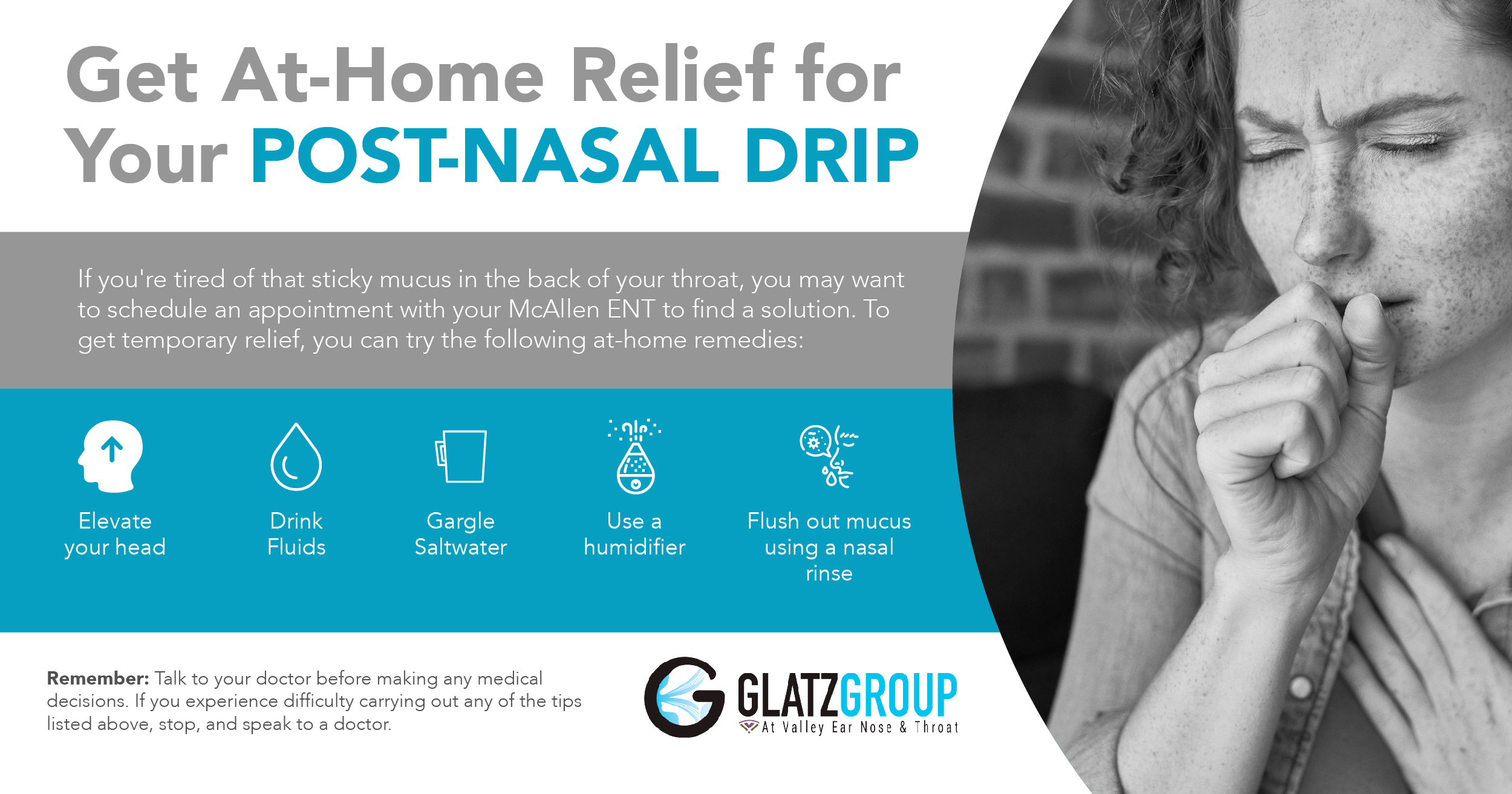
How Can I Treat Post Nasal Drip at Home?
If your symptoms are mild, there are several simple measures that may help reduce throat irritation and make mucus easier to clear.
Stay Hydrated
Drinking enough water can help keep mucus thinner and easier to clear.
Warm fluids may also feel soothing when post nasal drip is irritating the throat.
Use a Saline Nasal Spray or Nasal Rinse
Saline can help moisturize the nasal passages and remove mucus, allergens, and irritants.
If you use a nasal rinse, follow the product instructions and use water that is appropriate for nasal irrigation.
Use a Humidifier
Dry air can irritate the lining of the nose and throat. A clean humidifier may help add moisture to the air and make nasal irritation more comfortable.
Sleep With Your Head Slightly Elevated
Keeping your head and upper body slightly elevated may help reduce the feeling of mucus collecting in the throat while you sleep.
If nighttime sinus drainage is a frequent problem, read more about the best sleeping position for sinus drainage.
Gargle With Warm Salt Water
Warm salt water may help soothe throat irritation caused by drainage.
Avoid Smoke and Other Irritants
Tobacco smoke, vaping aerosols, strong fragrances, and other airborne irritants can worsen nasal and throat irritation.
If smoke seems to trigger your symptoms, read more about how smoking can affect the nose and sinuses.
Can Allergies Cause Post Nasal Drip?
Yes. Allergies can increase nasal inflammation and mucus production, which may lead to ongoing drainage down the back of the throat.
If your symptoms happen during certain seasons, around pets, dust, mold, or other triggers, allergies may be contributing.
Managing the allergy itself can be an important part of reducing post nasal drip.
Can Sinus Problems Cause Post Nasal Drip?
Sinus inflammation can increase mucus production and affect how mucus drains through the nose.
People with recurring sinus pressure, congestion, or sinus infections may also experience frequent drainage into the throat.
If post nasal drip occurs along with facial pressure, nasal obstruction, or recurring sinus symptoms, an ENT evaluation may help identify whether a sinus condition is contributing.
When Should You See an ENT for Post Nasal Drip?
Home care may be enough for mild symptoms, but persistent or recurring post nasal drip can sometimes signal an underlying problem that needs evaluation.
Consider seeing an ENT if you have:
- Symptoms that continue for several weeks
- Frequent or severe throat irritation
- Persistent coughing
- Recurring sinus infections
- Significant nasal congestion
- Difficulty breathing through the nose
- Reduced sense of smell
- Symptoms that repeatedly return after treatment
How Is Post Nasal Drip Treated at the Doctor’s Office?
Treatment depends on what is causing the drainage.
An ENT may examine the nose, throat, and sinuses and consider whether allergies, sinus inflammation, infection, reflux, structural problems, or another condition may be contributing.
Depending on the cause, treatment may involve medication, allergy management, treatment of a sinus condition, reflux management, or another approach based on the individual diagnosis.
Get Help With Post Nasal Drip in McAllen, TX
If post nasal drip keeps coming back, interferes with sleep, or causes ongoing coughing or throat irritation, Glatz Group can help determine what may be causing it.
Glatz Group provides sinus care in McAllen for patients throughout the Rio Grande Valley.
Get Answers About Your Post Nasal Drip
Book an Appointment
Ear pressure can make one or both ears feel clogged, full, or uncomfortable. It often happens when pressure is not equalizing properly through the eustachian tubes, which connect the middle ears to the back of the nose and throat.
Sinus congestion, allergies, colds, infections, and changes in air pressure can all contribute to that blocked feeling. Depending on the cause, there are several ways to relieve ear pressure at home, while persistent or severe symptoms may need evaluation by an ENT.
Why Does Ear Pressure Build Up?
Ear pressure commonly develops when the eustachian tube becomes blocked or does not open properly. When that happens, pressure and fluid can build up behind the eardrum.
Common causes of ear pressure include:
- Sinus congestion
- Seasonal or environmental allergies
- Colds and other upper respiratory infections
- Middle ear infections
- Changes in altitude during flying or driving
- Earwax buildup
- Eustachian tube dysfunction
The best way to relieve ear pressure depends on the underlying cause, which is why persistent or recurring symptoms may need an ENT evaluation.
How to Relieve Sinus Pressure in Your Ears at Home
If your ear pressure is related to sinus congestion, allergies, or a cold, reducing inflammation and helping the eustachian tubes open may provide relief.
Sinus Congestion and Allergies
When congestion affects the nose and sinuses, it can also interfere with the eustachian tubes and create pressure in the ears.
Some options that may help include:
- Drink plenty of water to help keep mucus thin
- Use a humidifier, especially when the air is dry
- Try a saline nasal spray or nasal rinse
- Blow your nose gently rather than forcefully
- Avoid tobacco smoke and other nasal irritants
- Manage allergies with medications recommended by your doctor or used according to the product instructions
Swallowing, yawning, or chewing gum can also help the eustachian tubes open and equalize pressure.
Pressure From Flying or Changes in Altitude
Changes in elevation can cause temporary pressure differences between the middle ear and the outside environment.
Swallowing, yawning, chewing gum, or sipping water can encourage the eustachian tubes to open and help equalize the pressure.
Earwax Buildup
A buildup of earwax can sometimes create a feeling of fullness or pressure in the ear. Over the counter earwax softening drops may help in some cases.
Do not place cotton swabs, tools, or other objects into the ear canal. These can push wax deeper into the ear or injure the ear canal or eardrum.
If you have ear tubes, a known or suspected eardrum perforation, previous ear surgery, significant ear pain, or drainage from the ear, speak with a medical professional before using ear drops or attempting to flush the ear.
When Should You See an ENT for Ear Pressure?
Ear pressure that lasts for several days, keeps returning, or continues to get worse should be evaluated. You should also consider seeing an ENT if pressure is accompanied by:
- Hearing loss or a noticeable change in hearing
- Significant ear pain
- Persistent ringing in the ear
- Dizziness or balance problems
- Fluid, blood, or drainage from the ear
- Repeated ear infections
- Fever or other signs of infection
Sudden hearing loss should be evaluated promptly.
Treating Ear Pressure at the Doctor’s Office
If ear pressure does not improve with conservative treatment, an ENT can examine the ear and determine whether the problem is related to congestion, fluid, infection, earwax, eustachian tube dysfunction, or another condition.
Treatment depends on the underlying cause. In some cases, medication or treatment of a sinus or allergy condition may be enough. When persistent middle ear fluid is present, additional procedures may be considered.
Myringotomy
A myringotomy is a procedure in which a small opening is made in the eardrum to allow trapped fluid in the middle ear to drain. It may be considered in certain cases involving persistent fluid or pressure.
Ear Tubes
Tympanostomy tubes, commonly called ear tubes, are small tubes placed in the eardrum to help ventilate the middle ear and reduce repeated fluid buildup. They are used only when appropriate for the underlying condition.
Get Help With Ear Pressure in McAllen, TX
If your ear pressure will not go away, keeps returning, or is affecting your hearing or comfort, Glatz Group can help determine what is causing it.
Ear pressure may be related to the ears, sinuses, allergies, or eustachian tubes. Identifying the cause is an important step toward finding the right treatment.
Glatz Group provides ENT care in McAllen for patients throughout the Rio Grande Valley.
Get Answers About Your Ear Pressure
Book an Appointment