Ear problems can affect hearing, balance, comfort, and everyday life. While some issues are temporary, others may require evaluation and treatment from an ear, nose, and throat specialist.
Understanding common symptoms can help you recognize when something may be affecting your ears. Below are four common ear problems, their possible causes, and some of the treatment options available.
1. Hearing Loss
Hearing loss is one of the most common ear problems evaluated by an ENT. Changes in hearing can happen gradually or suddenly, and the appropriate treatment depends on the type and cause of the hearing loss.
There are three primary types of hearing loss:
Conductive hearing loss: Occurs when sound is not transmitted efficiently through the outer or middle ear. Causes can include earwax buildup, fluid, infections, or problems involving the eardrum or middle ear.
Sensorineural hearing loss: Results from damage to structures of the inner ear or the nerve pathways involved in hearing. Aging and repeated exposure to loud noise are common causes.
Mixed hearing loss: A combination of conductive and sensorineural hearing loss.
Common Causes of Hearing Loss
Hearing loss can have many different causes. Identifying the cause helps determine which treatment options may be appropriate.
Age related changes
Exposure to loud noise
Earwax or fluid buildup
Ear infections
Certain medications
Head or ear injuries
Inherited conditions
Conditions affecting the inner ear or auditory nerve
Treatment depends on the type and severity of hearing loss. Options may include treating an underlying condition, hearing aids, other hearing devices, or surgical treatment in certain cases. If you notice a change in your hearing, an evaluation and hearing test can help determine the cause.
2. Ear Infections
Ear infections are especially common in children, but adults can develop them as well. Middle ear infections occur behind the eardrum and commonly involve inflammation and fluid buildup.
Common symptoms may include:
Ear pain
A feeling of pressure or fullness in the ear
Fluid draining from the ear
Fever
Temporary changes in hearing
An ENT can examine the ear with an otoscope to look for signs of infection, inflammation, or fluid. Some middle ear infections improve without antibiotics, while others may require medication or additional treatment depending on the patient's age, symptoms, and severity of the infection.
3. Tinnitus
Tinnitus is the perception of sound that does not come from an outside source. It is often described as ringing, buzzing, roaring, clicking, hissing, or humming in one or both ears.
Tinnitus varies from person to person. For some, it is occasional and mild. For others, it can interfere with concentration, sleep, hearing, and everyday activities.
Tinnitus may be associated with:
Hearing loss
Exposure to loud noise
Earwax buildup
Ear infections
Certain medications
Head or neck injuries
Ménière’s disease
Jaw joint problems
Certain blood vessel or medical conditions
Treatment depends on the underlying cause and how much tinnitus affects daily life. Options may include treating an underlying ear condition, hearing aids when hearing loss is present, sound therapy, and strategies that help reduce the impact of tinnitus.
4. Ménière’s Disease
Ménière’s disease is a disorder of the inner ear that can cause episodes of vertigo, hearing loss, tinnitus, and a feeling of pressure or fullness in the affected ear.
Symptoms can vary in frequency and severity. Some people experience episodes of intense vertigo along with changes in hearing or ringing in the ear. In severe cases, sudden loss of balance can occur.
The exact cause of Ménière’s disease is not fully understood. Diagnosis generally involves reviewing symptoms, examining the ears, and performing hearing and balance testing when appropriate.
There is currently no cure for Ménière’s disease, but treatment can help manage symptoms. Depending on the individual, treatment may include dietary changes, medications to help control dizziness, diuretics, vestibular rehabilitation, injections, hearing treatment, or surgery in more severe cases.
When Should You See an ENT for an Ear Problem?
Some ear symptoms resolve on their own, but persistent or worsening symptoms should be evaluated. Consider seeing an ENT if you are experiencing ongoing ear pain, pressure, ringing, repeated infections, dizziness, drainage, or changes in your hearing.
Sudden hearing loss or rapidly worsening hearing should be evaluated promptly.
Get Ear Care in McAllen, TX
If ear pain, pressure, hearing changes, ringing, dizziness, or repeated infections are affecting your daily life, Glatz Group provides comprehensive ear care for patients in McAllen and throughout the Rio Grande Valley.
Our team can evaluate your symptoms, identify the possible cause, and discuss treatment options based on your individual needs.
Balloon sinuplasty is designed to improve drainage through certain blocked sinus openings, but it is not a primary treatment for obstructive sleep apnea.
However, some people with sleep apnea also have chronic sinus congestion or nasal obstruction that makes nighttime breathing more difficult. In those cases, treating the sinus problem may improve nasal airflow and make sleep or other sleep apnea treatments more comfortable.
What Is Obstructive Sleep Apnea?
Obstructive sleep apnea, commonly called OSA, occurs when the upper airway repeatedly becomes blocked or narrowed during sleep.
These interruptions can reduce airflow and cause repeated awakenings throughout the night.
Common symptoms may include:
Loud or persistent snoring
Pauses in breathing during sleep
Waking up gasping or choking
Daytime sleepiness or fatigue
Morning headaches
Difficulty concentrating
Dry mouth after waking
Restless or disrupted sleep
Snoring alone does not necessarily mean someone has sleep apnea. A sleep evaluation is needed to determine whether OSA is present.
Can Sinus Problems Make Sleep Apnea Symptoms Feel Worse?
Nasal congestion and sinus inflammation can make it harder to breathe comfortably through the nose at night.
For someone who already has obstructive sleep apnea, additional nasal obstruction may make nighttime breathing feel more difficult and can sometimes make CPAP use less comfortable.
Treating nasal obstruction may improve breathing and sleep quality, but it does not necessarily eliminate the airway collapse responsible for OSA. Nasal treatment is often considered an additional part of a larger sleep apnea treatment plan. :chatgpt-content-reference{index="1"}
Can Balloon Sinuplasty Treat Sleep Apnea?
Balloon sinuplasty does not directly treat the throat or tongue base collapse that commonly causes obstructive sleep apnea.
Its purpose is to widen certain blocked sinus openings and improve sinus drainage.
If chronic sinusitis or poor sinus drainage is contributing to nasal obstruction, balloon sinuplasty may improve nasal breathing in an appropriately selected patient.
That improvement may make sleeping more comfortable or help some patients tolerate other sleep apnea treatments more easily, but balloon sinuplasty should not be considered a replacement for a proper sleep apnea evaluation or prescribed OSA treatment.
Can Better Nasal Breathing Help With CPAP?
For some patients, nasal obstruction can make CPAP treatment harder to tolerate.
Improving nasal airflow may make CPAP use more comfortable in selected patients. ENT evaluation can help determine whether allergies, sinusitis, a deviated septum, turbinate enlargement, or another nasal problem is contributing to difficulty breathing through the nose. :chatgpt-content-reference{index="2"}
Who Might Benefit From a Sinus Evaluation?
A sinus evaluation may be useful if you have sleep apnea along with symptoms such as:
Persistent nasal congestion
Recurring sinus infections
Chronic sinus pressure
Difficulty breathing through the nose
Frequent nighttime congestion
Post nasal drip
Reduced sense of smell
Difficulty tolerating CPAP because of nasal blockage
These symptoms do not automatically mean balloon sinuplasty is appropriate. An ENT first needs to determine what is causing the nasal obstruction.
What Other Conditions Can Affect Breathing During Sleep?
Sleep apnea can involve several areas of the upper airway, not just the nose and sinuses.
Possible contributing factors may include:
Enlarged tonsils
Soft palate or throat collapse
Tongue base obstruction
Jaw anatomy
Obesity
Nasal obstruction
A deviated septum
Enlarged turbinates
Because several areas may contribute to OSA, treatment should be based on an evaluation of the entire airway rather than nasal symptoms alone.
How Is Sleep Apnea Treated?
Treatment depends on the severity and cause of the sleep apnea.
Positive airway pressure therapy, including CPAP, is a standard treatment for many adults with obstructive sleep apnea. Other options may include oral appliances, weight management, positional treatment, or surgery depending on the patient. :chatgpt-content-reference{index="3"}
For selected patients who cannot tolerate CPAP, other treatments may also be considered after a complete evaluation.
Balloon sinuplasty may be considered when a patient has an appropriate sinus condition in addition to sleep related breathing concerns.
Examples may include chronic sinusitis, recurring sinus infections, persistent sinus pressure, or poor sinus drainage that has not improved enough with appropriate medical treatment.
If chronic sinus symptoms are making nasal breathing difficult, Glatz Group can determine whether balloon sinuplasty or another sinus treatment may be appropriate.
If you are dealing with both sleep apnea and chronic nasal or sinus problems, Glatz Group can evaluate how the nose and sinuses may be affecting your breathing.
Treating nasal obstruction may be one part of a broader sleep apnea treatment plan, but the right approach depends on the cause and severity of the condition.
Smoking can affect more than your lungs. Tobacco smoke and other inhaled irritants can also affect the lining of your nose and sinuses, which may contribute to congestion, irritation, drainage, and changes in how your nose feels.
If you regularly experience a stuffy nose, runny nose, post nasal drip, or sinus irritation after smoking or being around smoke, the exposure may be contributing to your symptoms.
How Does Smoking Affect Your Nose and Sinuses?
The lining of your nose and sinuses contains tiny structures called cilia. Cilia help move mucus, dust, allergens, and other particles through the nasal passages.
Tobacco smoke can irritate nasal tissue and interfere with normal cilia function. When mucus does not clear as effectively, congestion and drainage may become more noticeable.
Repeated smoke exposure may also contribute to ongoing inflammation in the nose and sinuses.
Can Smoking Cause Nasal Congestion?
Smoking can irritate and inflame the lining of the nasal passages. For some people, this can lead to swelling, increased mucus production, and a blocked or stuffy feeling in the nose.
Symptoms may be more noticeable after smoking, after repeated exposure, or when other conditions such as allergies or sinus inflammation are already present.
Can Smoking Cause Post Nasal Drip?
Smoking may contribute to post nasal drip by irritating the nasal passages and affecting how mucus moves through the nose and sinuses.
Post nasal drip occurs when mucus drains down the back of the throat. This can lead to:
Frequent throat clearing
Coughing
A feeling of mucus in the throat
Throat irritation
Hoarseness in some cases
If post nasal drip is persistent, there may be other contributing factors such as allergies, sinus inflammation, reflux, or another ENT condition.
Can Smoking Cause a Runny Nose?
Smoke can act as an irritant to the nasal lining. In some people, that irritation may trigger increased mucus production and cause the nose to run.
A runny nose that repeatedly occurs after smoking or smoke exposure may be a sign that the nasal passages are reacting to the irritants being inhaled.
Can Smoking Cause a Stuffy Nose?
Yes, smoke exposure can contribute to nasal swelling and congestion. This may make the nose feel blocked or stuffy even when there is no infection present.
If nasal congestion continues even when you are not exposed to smoke, allergies, chronic sinusitis, structural nasal problems, or another condition may also be involved.
Can Smoking Affect Sinus Infections?
Smoking does not mean that every person will develop a sinus infection, but smoke exposure can irritate the nose and sinuses and may make existing sinus symptoms harder to manage.
If you already have a sinus infection, avoiding smoke may help reduce additional irritation while your sinuses recover.
You do not have to smoke yourself to experience nasal irritation from tobacco smoke.
Secondhand smoke can irritate the nose, throat, and respiratory system and may make congestion, coughing, or sinus symptoms more noticeable in some people.
What About Vaping or Other Types of Smoke?
Vaping aerosols, marijuana smoke, cigar smoke, and other inhaled substances can also contain particles or chemicals that irritate the nose and respiratory system.
The exact effects vary depending on the substance, frequency of exposure, and the individual, but persistent congestion, drainage, or irritation after exposure should not be ignored.
Can Quitting Smoking Help Your Sinuses?
Reducing or stopping exposure to smoke removes an ongoing source of irritation from the nose and respiratory system.
Some people may notice improvements in congestion, coughing, nasal irritation, or their sense of smell after they stop smoking, although the amount of improvement and the timeline can vary.
If you need help quitting, your primary care provider can discuss treatment options and resources that may help.
When Should You See an ENT for Sinus Problems?
If congestion, post nasal drip, runny nose, sinus pressure, or nasal irritation keeps returning, an ENT can help determine whether smoke exposure is the main cause or whether another condition is also contributing.
Consider seeing an ENT if you experience:
Persistent nasal congestion
Recurring sinus infections
Frequent post nasal drip
Ongoing sinus pressure
Reduced sense of smell
Difficulty breathing through your nose
Symptoms that continue even after reducing smoke exposure
Get Help With Sinus Problems in McAllen, TX
If smoking, allergies, or chronic sinus problems are affecting your breathing or comfort, Glatz Group can help determine what may be causing your symptoms.
Glatz Group provides sinus care in McAllen for patients throughout the Rio Grande Valley.
Post nasal drip happens when mucus from the nose and sinuses drains down the back of the throat. It can cause frequent throat clearing, coughing, irritation, a feeling of mucus in the throat, and sometimes a sore throat or bad breath.
Many cases improve with simple measures at home, but persistent or recurring post nasal drip may be related to allergies, sinus inflammation, reflux, infection, or another ENT condition.
How Do I Know If I Have Post Nasal Drip?
Post nasal drip can feel different from person to person, but common symptoms include:
Frequent throat clearing
A feeling of mucus draining down the throat
Coughing, especially at night
A sore or irritated throat
Hoarseness
Bad breath
A feeling that you need to swallow often
These symptoms can also occur with other conditions, so ongoing symptoms may need an evaluation to determine the underlying cause.
What Causes Post Nasal Drip?
Post nasal drip is not a diagnosis by itself. It is a symptom that can develop for several different reasons.
Common causes include:
Seasonal or environmental allergies
Colds and other respiratory infections
Sinus inflammation or sinusitis
Dry air
Smoke and other airborne irritants
Changes in weather
Reflux
Structural nasal problems
Because treatment depends on the cause, persistent symptoms should not always be treated the same way.
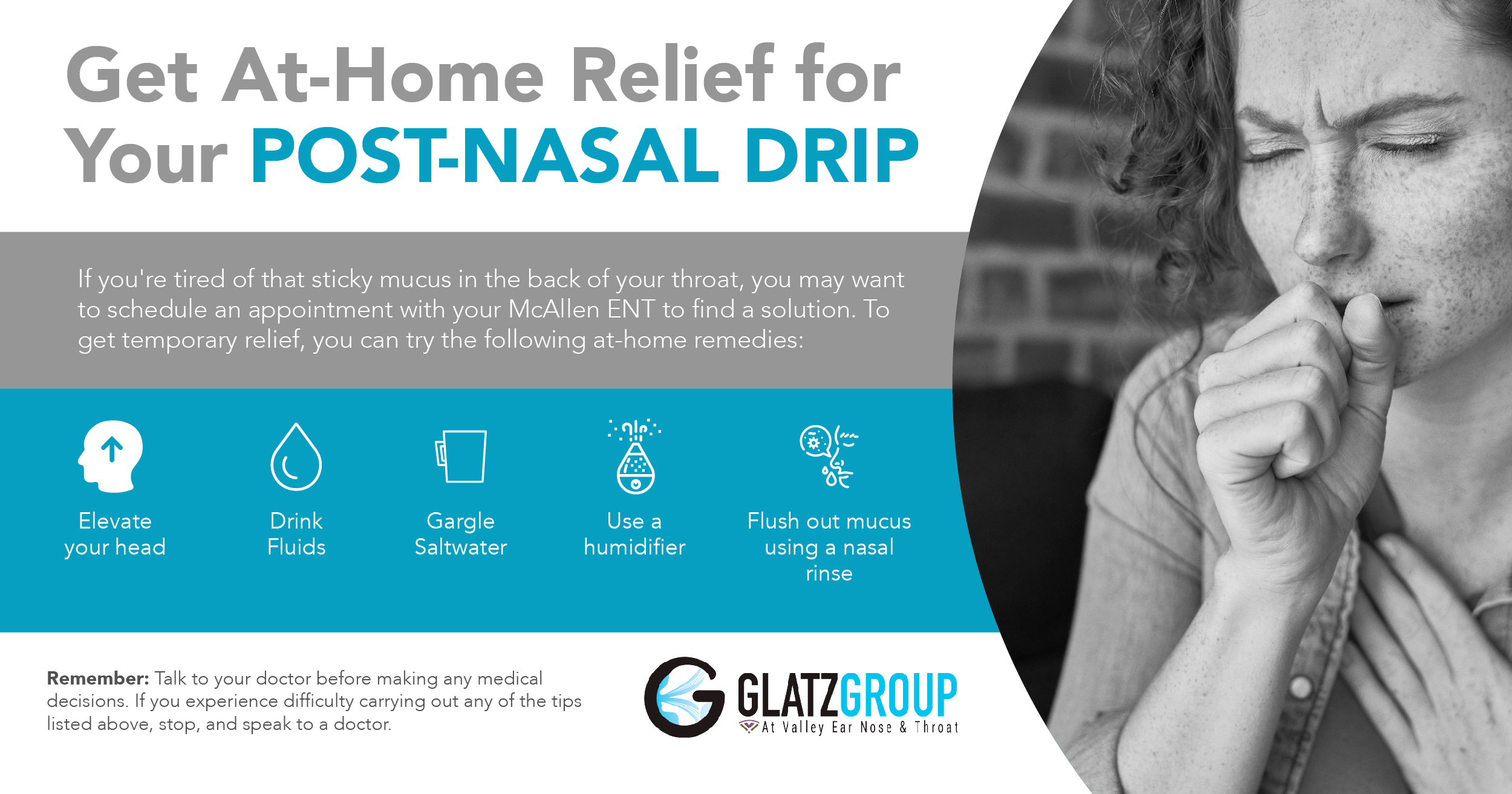
How Can I Treat Post Nasal Drip at Home?
If your symptoms are mild, there are several simple measures that may help reduce throat irritation and make mucus easier to clear.
Stay Hydrated
Drinking enough water can help keep mucus thinner and easier to clear.
Warm fluids may also feel soothing when post nasal drip is irritating the throat.
Use a Saline Nasal Spray or Nasal Rinse
Saline can help moisturize the nasal passages and remove mucus, allergens, and irritants.
If you use a nasal rinse, follow the product instructions and use water that is appropriate for nasal irrigation.
Use a Humidifier
Dry air can irritate the lining of the nose and throat. A clean humidifier may help add moisture to the air and make nasal irritation more comfortable.
Sleep With Your Head Slightly Elevated
Keeping your head and upper body slightly elevated may help reduce the feeling of mucus collecting in the throat while you sleep.
Yes. Allergies can increase nasal inflammation and mucus production, which may lead to ongoing drainage down the back of the throat.
If your symptoms happen during certain seasons, around pets, dust, mold, or other triggers, allergies may be contributing.
Managing the allergy itself can be an important part of reducing post nasal drip.
Can Sinus Problems Cause Post Nasal Drip?
Sinus inflammation can increase mucus production and affect how mucus drains through the nose.
People with recurring sinus pressure, congestion, or sinus infections may also experience frequent drainage into the throat.
If post nasal drip occurs along with facial pressure, nasal obstruction, or recurring sinus symptoms, an ENT evaluation may help identify whether a sinus condition is contributing.
When Should You See an ENT for Post Nasal Drip?
Home care may be enough for mild symptoms, but persistent or recurring post nasal drip can sometimes signal an underlying problem that needs evaluation.
Consider seeing an ENT if you have:
Symptoms that continue for several weeks
Frequent or severe throat irritation
Persistent coughing
Recurring sinus infections
Significant nasal congestion
Difficulty breathing through the nose
Reduced sense of smell
Symptoms that repeatedly return after treatment
How Is Post Nasal Drip Treated at the Doctor’s Office?
Treatment depends on what is causing the drainage.
An ENT may examine the nose, throat, and sinuses and consider whether allergies, sinus inflammation, infection, reflux, structural problems, or another condition may be contributing.
Depending on the cause, treatment may involve medication, allergy management, treatment of a sinus condition, reflux management, or another approach based on the individual diagnosis.
Get Help With Post Nasal Drip in McAllen, TX
If post nasal drip keeps coming back, interferes with sleep, or causes ongoing coughing or throat irritation, Glatz Group can help determine what may be causing it.
Glatz Group provides sinus care in McAllen for patients throughout the Rio Grande Valley.
Ear pressure can make one or both ears feel clogged, full, or uncomfortable. It often happens when pressure is not equalizing properly through the eustachian tubes, which connect the middle ears to the back of the nose and throat.
Sinus congestion, allergies, colds, infections, and changes in air pressure can all contribute to that blocked feeling. Depending on the cause, there are several ways to relieve ear pressure at home, while persistent or severe symptoms may need evaluation by an ENT.
Why Does Ear Pressure Build Up?
Ear pressure commonly develops when the eustachian tube becomes blocked or does not open properly. When that happens, pressure and fluid can build up behind the eardrum.
Common causes of ear pressure include:
Sinus congestion
Seasonal or environmental allergies
Colds and other upper respiratory infections
Middle ear infections
Changes in altitude during flying or driving
Earwax buildup
Eustachian tube dysfunction
The best way to relieve ear pressure depends on the underlying cause, which is why persistent or recurring symptoms may need an ENT evaluation.
How to Relieve Sinus Pressure in Your Ears at Home
If your ear pressure is related to sinus congestion, allergies, or a cold, reducing inflammation and helping the eustachian tubes open may provide relief.
Sinus Congestion and Allergies
When congestion affects the nose and sinuses, it can also interfere with the eustachian tubes and create pressure in the ears.
Some options that may help include:
Drink plenty of water to help keep mucus thin
Use a humidifier, especially when the air is dry
Try a saline nasal spray or nasal rinse
Blow your nose gently rather than forcefully
Avoid tobacco smoke and other nasal irritants
Manage allergies with medications recommended by your doctor or used according to the product instructions
Swallowing, yawning, or chewing gum can also help the eustachian tubes open and equalize pressure.
Pressure From Flying or Changes in Altitude
Changes in elevation can cause temporary pressure differences between the middle ear and the outside environment.
Swallowing, yawning, chewing gum, or sipping water can encourage the eustachian tubes to open and help equalize the pressure.
Earwax Buildup
A buildup of earwax can sometimes create a feeling of fullness or pressure in the ear. Over the counter earwax softening drops may help in some cases.
Do not place cotton swabs, tools, or other objects into the ear canal. These can push wax deeper into the ear or injure the ear canal or eardrum.
If you have ear tubes, a known or suspected eardrum perforation, previous ear surgery, significant ear pain, or drainage from the ear, speak with a medical professional before using ear drops or attempting to flush the ear.
When Should You See an ENT for Ear Pressure?
Ear pressure that lasts for several days, keeps returning, or continues to get worse should be evaluated. You should also consider seeing an ENT if pressure is accompanied by:
Hearing loss or a noticeable change in hearing
Significant ear pain
Persistent ringing in the ear
Dizziness or balance problems
Fluid, blood, or drainage from the ear
Repeated ear infections
Fever or other signs of infection
Sudden hearing loss should be evaluated promptly.
Treating Ear Pressure at the Doctor’s Office
If ear pressure does not improve with conservative treatment, an ENT can examine the ear and determine whether the problem is related to congestion, fluid, infection, earwax, eustachian tube dysfunction, or another condition.
Treatment depends on the underlying cause. In some cases, medication or treatment of a sinus or allergy condition may be enough. When persistent middle ear fluid is present, additional procedures may be considered.
Myringotomy
A myringotomy is a procedure in which a small opening is made in the eardrum to allow trapped fluid in the middle ear to drain. It may be considered in certain cases involving persistent fluid or pressure.
Ear Tubes
Tympanostomy tubes, commonly called ear tubes, are small tubes placed in the eardrum to help ventilate the middle ear and reduce repeated fluid buildup. They are used only when appropriate for the underlying condition.
Get Help With Ear Pressure in McAllen, TX
If your ear pressure will not go away, keeps returning, or is affecting your hearing or comfort, Glatz Group can help determine what is causing it.
Ear pressure may be related to the ears, sinuses, allergies, or eustachian tubes. Identifying the cause is an important step toward finding the right treatment.
Glatz Group provides ENT care in McAllen for patients throughout the Rio Grande Valley.
Ear pain can come from the ear itself, but it can also come from nearby areas such as the jaw, teeth, throat, or sinuses.
Some causes are temporary and improve on their own, while persistent or severe ear pain may need an examination to determine what is actually causing it.
Why Does My Ear Hurt?
Common causes of ear pain include ear infections, pressure changes, earwax buildup, irritation of the ear canal, jaw problems, dental problems, and referred pain from the throat or nearby structures.
The location and type of pain, along with symptoms such as hearing loss, drainage, fever, dizziness, congestion, or jaw discomfort, can help narrow down the cause.
1. Ear Infections
Ear infections are a common cause of ear pain, especially in children, but adults can develop them as well.
Outer Ear Infection
An outer ear infection, often called swimmer's ear, affects the ear canal.
It may develop after water remains in the ear canal or when the skin is irritated by scratching, cotton swabs, earbuds, hearing aids, or other objects.
Symptoms may include:
Ear pain
Itching
Redness or swelling
Drainage
Tenderness when touching the outer ear
Middle Ear Infection
A middle ear infection occurs behind the eardrum and may develop after a cold or another upper respiratory infection.
Fluid can collect behind the eardrum and cause pressure, pain, temporary hearing changes, or fever.
Earwax normally helps protect the ear canal, but impacted wax can cause pain, pressure, fullness, itching, or muffled hearing.
Do not place cotton swabs or other objects into the ear canal, since this can push wax deeper or injure the ear.
4. Changes in Air Pressure
Flying, driving through elevation changes, or diving can create a pressure difference between the middle ear and the outside environment.
This may cause temporary pain, pressure, popping, or muffled hearing until the pressure equalizes.
5. Jaw Joint Problems
The temporomandibular joint, commonly called the TMJ, sits very close to the ear.
Jaw clenching, teeth grinding, arthritis, or other TMJ problems can sometimes cause pain that feels like it is coming from the ear.
Clues that the jaw may be involved include:
Pain when chewing
Jaw clicking or popping
Jaw stiffness
Pain near the ear without signs of an ear infection
6. Dental Problems
An infected tooth, impacted tooth, or other dental problem can cause referred pain that is felt in the ear.
Ear pain accompanied by tooth pain, gum swelling, or jaw tenderness may need dental evaluation.
7. Throat or Tonsil Problems
Pain from the throat can sometimes be felt in the ear because the throat and ear share nerve pathways.
Conditions such as tonsillitis, strep throat, severe throat inflammation, or other throat problems may cause ear pain even when the ear itself is normal. Cleveland Clinic notes that this type of referred ear pain is common when throat and ear pain occur together. :chatgpt-content-reference{index="2"}
8. Sinus and Nasal Problems
Sinus congestion and nasal inflammation can affect pressure around the eustachian tubes and contribute to ear fullness or discomfort.
If ear pain occurs along with congestion, facial pressure, allergies, or sinus symptoms, the nose and sinuses may be contributing.
9. Skin Conditions or Irritation of the Ear Canal
Conditions such as eczema can affect the skin in or around the ear and may cause itching, irritation, swelling, or discomfort.
Cleveland Clinic notes that ear eczema can affect the outer ear and ear canal and can sometimes contribute to pain if scratching or irritation leads to infection. :chatgpt-content-reference{index="3"}
10. Less Common Causes of Ear Pain
Less common causes may include:
A perforated eardrum
Cholesteatoma
Facial nerve pain
Injury to the ear
Foreign objects in the ear canal
Growths or tumors affecting the ear or nearby structures
These causes are less common, but persistent or unexplained pain is one reason an examination can be useful.
Why Does Only One Ear Hurt?
Pain in only one ear can still have many causes, including an ear infection, earwax buildup, TMJ problems, a dental problem, irritation of the ear canal, or referred pain from one side of the throat.
Persistent one sided ear pain should be evaluated, especially when it is accompanied by hearing changes, drainage, a lump, throat symptoms, or other unexplained symptoms.
When Should You See an ENT for Ear Pain?
Consider seeing an ENT if your ear pain:
Does not improve
Keeps returning
Becomes severe
Is accompanied by hearing loss
Occurs with dizziness or balance problems
Occurs with fluid, blood, or drainage from the ear
Is associated with repeated ear infections
Occurs along with persistent throat symptoms
Sudden hearing loss, new facial weakness, significant trauma, or severe rapidly worsening symptoms should be evaluated promptly.
Get Help With Ear Pain in McAllen, TX
If ear pain will not go away or keeps returning, Glatz Group can examine the ear and determine whether the pain is coming from an infection, pressure problem, earwax, the jaw, the throat, or another condition.
Glatz Group provides ENT care in McAllen for patients throughout the Rio Grande Valley.
Ear pressure often feels like fullness, clogging, or a need to pop your ears. It may happen temporarily with allergies, sinus congestion, a cold, or changes in altitude.
But when ear pressure will not go away, keeps returning, or begins affecting your hearing or balance, it may be time to have the cause evaluated.
Why Won’t My Ear Pressure Go Away?
Persistent ear pressure can have several possible causes. One of the most common is eustachian tube dysfunction, which occurs when the tubes that help regulate pressure between the middle ear and the back of the nose do not open properly.
Other possible causes include:
Sinus congestion
Seasonal or environmental allergies
Fluid behind the eardrum
Middle ear infections
Earwax buildup
Changes in air pressure
Jaw joint problems
Inner ear conditions
The sensation may feel similar even when the underlying cause is different, which is why persistent pressure sometimes requires an examination.
How Long Should Ear Pressure Last?
Temporary ear pressure caused by flying, elevation changes, or a mild cold may improve once the pressure equalizes or the congestion clears.
If the pressure lasts for several days, repeatedly returns, becomes painful, or does not improve as your other symptoms get better, an ENT evaluation may help determine what is causing it.
When Should I See an ENT for Ear Pressure?
Consider seeing an ENT if your ear pressure is persistent or accompanied by other symptoms such as:
Hearing loss or noticeable changes in hearing
Persistent or worsening ear pain
Ringing or other sounds in the ear
Dizziness or balance problems
Repeated ear infections
Fluid or drainage from the ear
A feeling that your ears remain clogged despite home measures
Pressure that repeatedly returns without an obvious reason
An ENT can examine the ear canal and eardrum, evaluate middle ear pressure, and determine whether the symptoms may be related to the ears, sinuses, allergies, jaw, or another condition.
Can Eustachian Tube Dysfunction Cause Constant Ear Pressure?
Yes. Eustachian tube dysfunction is a common reason people experience pressure, fullness, popping, or muffled hearing.
The eustachian tubes normally open when you swallow or yawn to help equalize pressure. Allergies, sinus inflammation, respiratory infections, and other conditions can interfere with how well those tubes function.
If this problem continues, an ENT can determine whether eustachian tube dysfunction is contributing to your symptoms and discuss appropriate treatment options.
Can Sinus Problems Cause Ongoing Ear Pressure?
The ears, nose, and throat are closely connected. Swelling and congestion around the back of the nose can affect the openings of the eustachian tubes and create a sensation of pressure or fullness in the ears.
If your ear pressure happens along with nasal congestion, facial pressure, allergies, or recurring sinus problems, treating the underlying nasal or sinus condition may also help the ear symptoms.
Less commonly, persistent ear pressure may be associated with conditions involving the middle ear, inner ear, or nearby structures.
Ménière’s Disease
Ménière’s disease is an inner ear disorder that can cause episodes of vertigo, hearing changes, tinnitus, and a feeling of pressure or fullness in one ear.
Cholesteatoma
A cholesteatoma is an abnormal growth of skin cells behind the eardrum. It can sometimes cause hearing loss, drainage, recurring infections, or a feeling of pressure.
Jaw Joint Problems
Problems involving the temporomandibular joint, commonly called the TMJ, can sometimes create sensations of pressure or discomfort around the ear because the joint is located very close to the ear canal.
These conditions are not the most common causes of ear pressure, but persistent symptoms are one reason an examination can be useful.
When Is Ear Pressure an Emergency?
Some ear symptoms should be evaluated promptly rather than waiting for a routine appointment.
Seek prompt medical attention if ear pressure is accompanied by:
Sudden hearing loss
Severe or rapidly worsening pain
Significant dizziness or loss of balance
Facial weakness
Blood or significant drainage from the ear
Recent significant head or ear trauma
A foreign object that cannot be safely removed
Sudden hearing loss in particular should be evaluated promptly.
Get Help With Persistent Ear Pressure in McAllen, TX
If your ear pressure will not go away, keeps returning, or is affecting your hearing or daily comfort, Glatz Group can help determine what may be causing it.
The cause may involve the ear itself, eustachian tube dysfunction, allergies, sinus inflammation, or another condition, so the right treatment depends on identifying the underlying problem.
Glatz Group provides ENT care in McAllen for patients throughout the Rio Grande Valley.
After balloon sinuplasty, proper aftercare can help support healing and reduce irritation while the nose and sinuses recover.
Your exact instructions will depend on your procedure, medical history, and whether any additional sinus treatment was performed, so always follow the recommendations provided by your ENT.
This guide focuses specifically on what to do after balloon sinuplasty, what to avoid, and when to contact your doctor during recovery.
What Should You Do After Balloon Sinuplasty?
The first few days after balloon sinuplasty are an important part of recovery. Your doctor may give you specific instructions about rest, nasal care, medications, and activity.
General aftercare may include:
Resting after the procedure
Keeping your head slightly elevated
Using saline spray or rinses if directed
Taking medications exactly as instructed
Avoiding strenuous activity until cleared
Attending follow up appointments
Should You Rest After Balloon Sinuplasty?
Many patients are able to return to light activity fairly quickly, but rest can still be helpful during the first part of recovery.
Avoid pushing yourself if you are experiencing fatigue, pressure, congestion, or discomfort.
Should You Keep Your Head Elevated?
Sleeping or resting with your head slightly elevated may help reduce the feeling of congestion and may make drainage more comfortable.
A wedge pillow or extra pillow may help keep your upper body raised without forcing your neck into an uncomfortable position.
Can You Blow Your Nose After Balloon Sinuplasty?
Patients are often advised to avoid forceful nose blowing for a period of time after sinus procedures.
Forceful pressure may irritate healing tissue or increase the chance of bleeding.
Your ENT will tell you when it is safe to resume normal nose blowing based on your specific treatment.
Should You Use Saline Spray or Nasal Rinses?
Saline spray or nasal rinses may be recommended to help keep the nasal passages moist and support normal healing.
Use saline only according to your doctor's instructions and follow the recommended frequency and technique.
What Activities Should You Avoid After Balloon Sinuplasty?
Temporary activity restrictions may be recommended while the nose and sinuses heal.
Depending on your treatment plan, you may be advised to avoid:
Strenuous exercise
Heavy lifting
Forceful nose blowing
Smoking and vaping
Strong airborne irritants
Activities that increase the risk of hitting or injuring the nose
The length of these restrictions varies by patient, so follow the instructions given by your treating physician.
When Can You Exercise After Balloon Sinuplasty?
Light walking may be appropriate for some patients, but strenuous activity should usually be resumed gradually and according to your doctor's instructions.
Returning to intense exercise too quickly may increase pressure, discomfort, or bleeding.
When Can You Return to Work?
Some patients return to work relatively soon after balloon sinuplasty, especially if their job is not physically demanding.
The appropriate timing depends on how you feel, the type of work you do, whether sedation was used, and whether other procedures were performed.
Your ENT can give you a more specific return to work recommendation.
Can You Drive After Balloon Sinuplasty?
Driving recommendations depend on whether sedation, pain medication, or other medications that affect alertness were used.
If your doctor instructs you not to drive, arrange for someone else to take you home.
Do not drive until you are medically cleared and feel fully alert.
What Symptoms Are Normal After Balloon Sinuplasty?
Temporary symptoms may occur as the nose and sinuses heal.
These can include:
Mild congestion
Pressure or tenderness
Minor bloody drainage
Fatigue
Temporary swelling or irritation
Symptoms should generally improve with time, although recovery varies from person to person.
When Should You Contact Your ENT?
Contact your medical provider if your symptoms seem severe, unexpected, or are getting worse instead of improving.
Examples may include:
Heavy or persistent bleeding
Severe or worsening pain
High fever
Significant swelling
Severe headache
Vision changes
Symptoms that suddenly worsen
Your ENT can tell you which symptoms require immediate evaluation based on your specific treatment.
Why Are Follow Up Visits Important?
Follow up appointments allow your ENT to evaluate healing and determine whether additional care is needed.
Keep your scheduled follow up visits even if you are feeling better, since your doctor may need to examine areas you cannot evaluate on your own.
If you have a sinus infection, smoking may make an already uncomfortable situation worse. Cigarette smoke and other inhaled irritants can irritate the lining of the nose and sinuses, increase inflammation, and interfere with the normal processes that help move mucus out of the nasal passages.
Avoiding smoke while your sinuses are inflamed may help reduce additional irritation while you recover. Persistent, recurring, or severe sinus symptoms may also need evaluation by an ear, nose, and throat specialist.
Can You Smoke With a Sinus Infection?
Smoking while you have a sinus infection is generally not helpful for irritated nasal and sinus tissue. Smoke can further irritate the lining of the nose, increase congestion, and make symptoms such as pressure, drainage, and coughing feel more noticeable.
Your nose and sinuses contain tiny structures called cilia that help move mucus and trapped particles through the respiratory system. Exposure to tobacco smoke can interfere with normal cilia function, which can make it harder for the nose and sinuses to clear mucus effectively.
Can Smoking Make a Sinus Infection Worse?
Smoking does not mean that every sinus infection will become more severe, but continued exposure to smoke can contribute to inflammation and irritation while the sinuses are already affected.
Symptoms that may feel worse with smoke exposure include:
Nasal congestion
Facial pressure or discomfort
Post nasal drainage
Runny nose
Throat irritation
Coughing
Reduced sense of smell
Avoiding cigarettes, cigars, vaping products, secondhand smoke, and other airborne irritants may help prevent additional irritation while your symptoms improve.
How Does Smoking Affect Your Nose and Sinuses?
The lining of your nose and sinuses continuously produces mucus. That mucus helps trap dust, allergens, and other particles before they travel farther into the respiratory system.
Cilia help move that mucus through the nasal passages. Tobacco smoke contains chemicals and particles that can irritate nasal tissue and impair normal mucus clearance.
Over time, repeated smoke exposure may contribute to chronic nasal inflammation, congestion, changes in smell, and ongoing sinus symptoms.
Can Secondhand Smoke Affect Your Sinuses?
You do not have to smoke yourself to experience irritation from tobacco smoke. Secondhand smoke can irritate the nose, throat, and respiratory system.
For people who already have allergies, sinus inflammation, or respiratory problems, exposure to smoke may make congestion and other symptoms more noticeable.
Does Smoking Cause Chronic Sinusitis?
Chronic sinusitis is inflammation of the nose and sinuses that persists for an extended period. It can have several causes and contributing factors.
Smoking and repeated exposure to tobacco smoke may contribute to ongoing nasal and sinus inflammation and can make existing sinus problems harder to manage.
If you frequently experience congestion, facial pressure, drainage, or repeated sinus infections, an ENT evaluation can help determine whether chronic sinusitis or another condition is contributing to your symptoms.
What About Smoking After Sinus Surgery?
Smoking can interfere with normal healing after many surgical procedures and may irritate tissue that is recovering from sinus treatment.
Patients undergoing sinus surgery should follow their surgeon's specific instructions about smoking before and after the procedure.
If you are considering a procedure such as balloon sinuplasty or another sinus treatment, tell your doctor about smoking, vaping, and other tobacco use so your care plan can account for it.
Can Quitting Smoking Help Your Sinuses?
Reducing or stopping exposure to tobacco smoke removes an ongoing source of irritation from the nose and respiratory system.
Some people may notice improvements in congestion, coughing, nasal irritation, or their sense of smell after they stop smoking, although recovery varies from person to person.
If you need help quitting, your primary care provider can discuss resources and treatment options that may make quitting easier.
When Should You See an ENT for a Sinus Infection?
Many short term sinus symptoms improve with time, but an ENT evaluation may be appropriate when symptoms are persistent, severe, or repeatedly return.
Consider seeing an ENT if you experience:
Recurring sinus infections
Persistent nasal congestion
Significant facial pain or pressure
Drainage that does not improve
Reduced sense of smell
Symptoms that continue despite treatment
Sinus problems that repeatedly interfere with sleep or daily activities
Get Help With Sinus Problems in McAllen, TX
If sinus infections, congestion, or drainage keep coming back, Glatz Group can help determine what may be contributing to your symptoms.
Smoking may be one factor, but allergies, chronic inflammation, structural problems, and other conditions can also affect the nose and sinuses.
Glatz Group provides sinus care in McAllen for patients throughout the Rio Grande Valley.
Sinus pressure, congestion, drainage, and headaches can make it difficult to get comfortable at night. When your nose and sinuses feel blocked, even falling asleep can become frustrating.
Your sleeping position can affect how congestion and drainage feel overnight. For many people, keeping the head elevated can make breathing more comfortable and help reduce the feeling of pressure caused by congestion.
What Is the Best Sleeping Position for Sinus Drainage?
If sinus drainage or congestion is keeping you awake, sleeping with your head elevated is often the most comfortable position.
Raising your head and upper body may help mucus drain more naturally and may reduce the feeling of pressure or congestion while you sleep.
Some options include:
Use an extra pillow to gently elevate your head
Use a wedge pillow to raise your head and upper body
Sleep in an adjustable bed if one is available
Rest in a recliner temporarily if lying flat feels uncomfortable
The goal is to keep your head comfortably elevated rather than completely flat.
Should You Sleep on Your Back With Sinus Problems?
Sleeping on your back with your head elevated can be comfortable for many people dealing with sinus pressure, congestion, or drainage.
Keeping your upper body slightly raised may make it easier to breathe through the night and can help prevent mucus from collecting in the back of the throat.
If sleeping on your back is uncomfortable, choose the position that allows you to breathe and rest most comfortably while keeping your head slightly elevated.
Can Sleeping on Your Side Help Sinus Congestion?
Side sleeping is not necessarily harmful when you have sinus problems. However, some people notice that the nostril closest to the mattress feels more congested because nasal airflow can naturally shift depending on body position.
If one side of your nose feels especially blocked, changing sides or elevating your head may help you feel more comfortable.
What Is the Best Sleeping Position With a Sinus Infection?
If you have symptoms of a sinus infection, sleeping with your head elevated may help reduce the feeling of congestion and drainage overnight.
Your sleeping position will not treat an infection, but it may make symptoms more manageable while your body recovers or while you are receiving treatment.
If symptoms are severe, continue to worsen, or do not improve, an ENT evaluation may help determine what is causing the problem.
How to Sleep More Comfortably With Sinus Pressure
Your sleeping position is only one part of managing nighttime sinus symptoms. A few simple changes may also make it easier to rest.
Drink enough water throughout the day to stay hydrated
Use a saline nasal spray or rinse before bed if appropriate for you
Keep your bedroom clean and reduce dust when possible
Wash bedding regularly
Consider keeping pets out of the bedroom if pet allergies trigger symptoms
Use a humidifier if dry air is making nasal irritation worse
Avoid tobacco smoke and other nasal irritants
Follow your doctor’s recommendations for managing allergies or chronic sinus symptoms
Why Do Sinus Problems Feel Worse at Night?
Sinus symptoms can sometimes feel more noticeable at night because lying down changes how mucus drains and can make congestion feel more pronounced.
Allergies, dry air, bedroom irritants, and post nasal drainage can also contribute to nighttime discomfort.
When Should You See an ENT for Sinus Pressure or Drainage?
Occasional congestion may improve on its own, but recurring or persistent sinus symptoms may need further evaluation.
Consider seeing an ENT if you are experiencing:
Sinus pressure or congestion that keeps returning
Symptoms that continue for an extended period
Frequent sinus infections
Significant facial pain or pressure
Persistent nasal obstruction
Drainage that does not improve
Difficulty sleeping because of nasal or sinus symptoms
Get Help With Sinus Problems in McAllen, TX
If sinus pressure, congestion, or drainage is regularly interfering with your sleep, Glatz Group can help determine what may be causing your symptoms.
Treatment depends on the underlying problem, which may include allergies, inflammation, chronic sinusitis, structural nasal problems, or another condition affecting the nose and sinuses.
Glatz Group provides sinus care in McAllen for patients throughout the Rio Grande Valley.